
❓What is Poka-yoke?
Poka-yoke in manufacturing is a mistake-proofing method from the Toyota Production System, developed by Shigeo Shingo, that stops human error becoming a defect. It works in two ways: a)Prevention, where the mistake cannot physically be made. b)Detection, where the mistake is flagged as it happens.
On the line, a fixture holding the part while six M3 screws go in. It locates the bracket underneath in one way only, and clamps it square. However, it cannot tell you, after leaving the station whether all six screws went in or only four.
Nothing looks wrong afterwards. The bracket sits flat either way, the cover closes, and the functional test passes because the two missing screws are structural, not electrical. Maybe somebody finds out in a field return, maybe never.

Traditional fixtures hold the part perfectly but cannot verify if every manual step was completed.
Defects that clear the stations do not disappear, they live on in the field, in the hands of your customers. In 2025, US vehicle manufacturers issued 891 defect-related safety recalls covering 29,262,623 vehicles (NHTSA 2025 Annual Report on Safety Recalls). Every one of those started as something that passed a station.
📖 This article covers:
- What is poka-yoke, and the two things it can do
- 12 poka-yoke examples in manufacturing, grouped by the three classical types
- The three errors no physical poka-yoke catches, and why
- How an EV manufacturer reached 100% first pass yield at its poka-yoke station
What poka-yoke in manufacturing means, and the two things it was designed to do
Shigeo Shingo developed the method at Toyota in the 60s. He first called it baka-yoke, fool-proofing, then renamed it poka-yoke, mistake-proofing, after an operator took offense (Baka means idiot in Japanese). Shifting the premise to how competent people slip under time pressure, and the fix belongs in the equipment.
A poka-yoke does two jobs. Prevention makes the wrong action impossible: A male to male connector will never connect. Detection allows the action, but signals it when it happens: The screw was fastened with an under-torque, and the station lights turned from green to red.
Both are cheap, relatively. In most factories, around half of the poka-yoke fixtures on your floor was probably made in your own tool room out of an aluminium offcut, and it works just fine.
12 poka-yoke examples in manufacturing
Shingo grouped the devices by what they sense. Each one below is paired with the thing it cannot see, which is usually the more useful half.
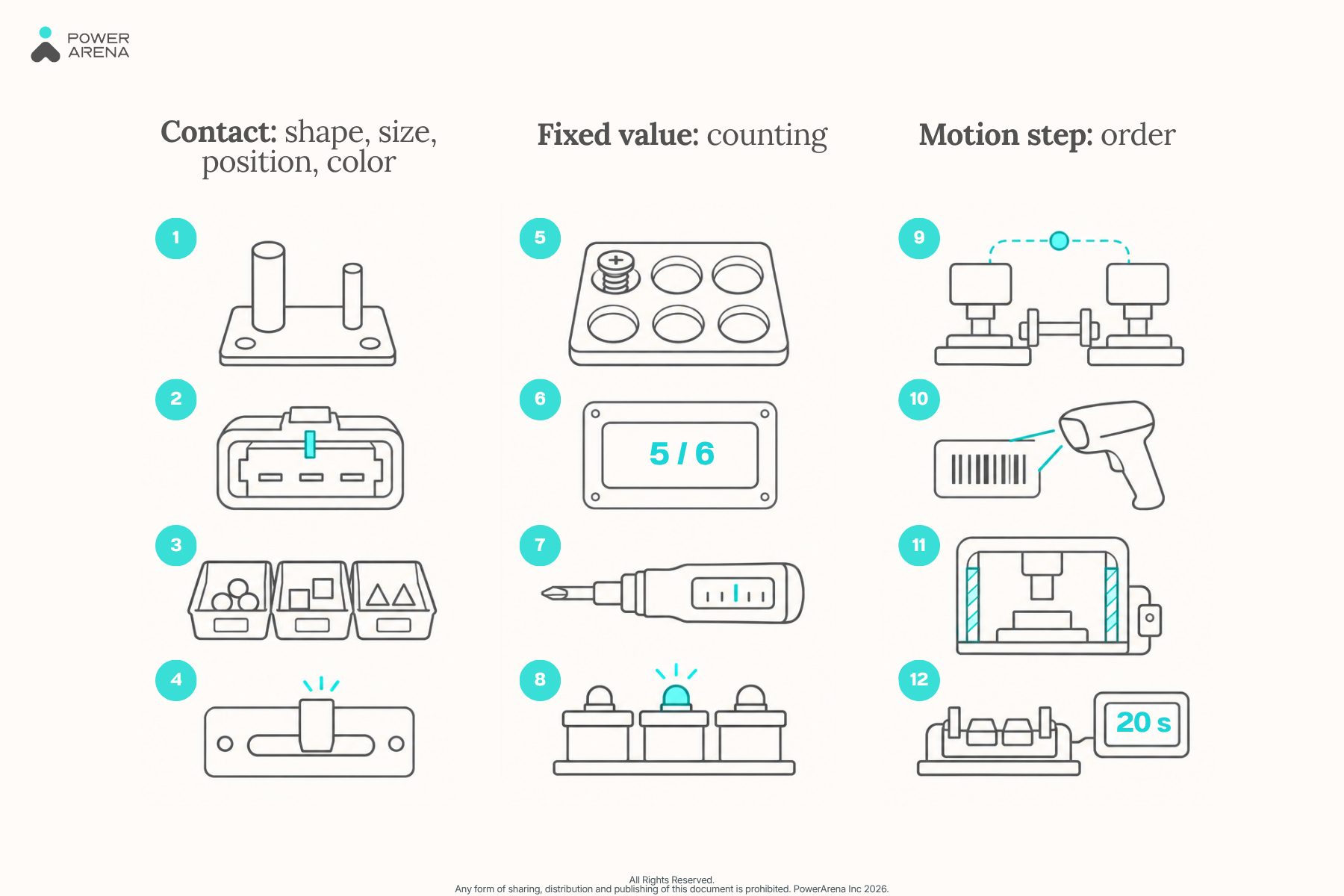
Classic poka-yoke methods rely on sensing physical states like shape, count, and order.
Contact method: sensing shape, size, position or color
1. Asymmetric locating pins. Two pins of different diameters, so the part will not drop in rotated 180 degrees. The operator feels it stop, turns the part around, and it seats. What the pins confirm is how the part sits at the start, not what happens to it after that.
2. Keyed connector shells. A polarizing rib lets the mating half enter one way only, which removes reversed-connector defects entirely. However, it cannot tell you the connector traveled all the way to the latch, rather than stopping a click short.
3. Color-coded bins. Variants get different bin colors or tray silhouettes, and wrong-part picks drop at almost no cost. The coding fails quietly: a supplier change arrives, two variants turn up in the same gray, and nothing on the bench announces it.
4. Go/no-go gauge. A slotted plate an oversized part will not pass through, so the verdict arrives in one motion, at the bench. It checks one dimension, on the units somebody remembered to gauge.
Fixed-value method: counting
5. Kitted trays with an exact count. Six screws per unit in the tray, so a screw still sitting there at the end means a hole is empty. One dropped screw, or one borrowed from the next kit, and the signal is gone.
6. Cycle counting on the fastening controller. The station is held until the controller counts six fastening cycles, which catches the operator who stops at five. It counts cycles, not holes: five screws plus one re-torque also reads as six.
7. Torque and angle monitoring. Each fastening is judged against a torque window and a rotation angle, and an out-of-spec result is flagged NG on the spot, at the station. What the driver cannot report is which of the six holes it was in.
8. Pick-to-light bins. A light marks the correct bin, a sensor registers the hand entering it, and the station holds until every bin has been visited. However, reaching into a bin is not the same event as putting the part into the unit.
Motion-step method: enforcing order
9. Sequence interlocks between stations. The clamp releases only after the previous station signals complete, so a unit cannot move down the line out of order. It orders machine events between stations, not hand movements inside one.
10. Scan gates on the tool. The driver stays disabled until the correct work order barcode is scanned, so the wrong program never runs. The scan proves a label was read. It does not prove the unit under the tool is the one that label belongs to.
11. Guard and lid interlocks. A limit switch confirms the guard is closed before the press will cycle, a safety device doing process duty as well. Guard closed is not the same thing as part loaded correctly.
12. Dwell timers on cure fixtures. The fixture holds the unit for its specified dwell and will not release early, so nobody can rush a cure to make up time. It times the fixture, not the bead: an operator who applied no adhesive at all waits out the same 20 seconds.
Every device above senses a physical state. A shape seated, a count reached, a switch closed. That is the reason poka-yoke is, relatively, cheap and reliable, and the reason there is some version of it on almost every line you have ever walked.
The three errors a physical poka-yoke cannot catch
A fixture answers one question, and answers it well: can this be assembled wrongly. It does not answer the question your quality team actually lives with, which is whether the work was performed at all. In three common cases, there is simply no physical state left for it to sense.
The step performed out of sequence
Sequence matters more than most process documents admit. Thread locker goes onto the screw before it is driven, not after. A torque pattern runs cross-wise, because the bracket distorts otherwise.
Back at the station, the fixture holds the part in one orientation for the whole cycle. So a unit built in the wrong order finishes in the same place, with the same things attached to it. All six screws are in. The torque log is full of OK and none of the exclamation marks. The defect this led to, a gasket that leaks in month seven, does not exist yet, and nothing at that station can see forward to it.
The step skipped entirely, where nothing changes state
This is the hard one, and, in most factories, the more common of the two.
Some steps leave a mark, and those are easy to mistake-proof: a screw goes in, a component seats, a label sticks. Others leave nothing at all to sense. Brushing lubricant onto a shaft. Wiping flux residue off a board. Routing a wire on the correct side of a rib, before the cover closes over it.
There is no sensor for the absence of an action that never had a physical signature in the first place. You can build a fixture that detects a missing screw, because a missing screw is a hole. You cannot build one that detects a missing wipe, because a surface nobody cleaned looks exactly like a surface somebody cleaned. If you have ever tried to specify a device for a step like this, you already know how it ends: the step stays on the SOP, and verification quietly falls back to trust. That is a limit of contact sensing, not a failure of your engineering. It is also where SOP compliance work lives.
The step performed on the wrong unit
High-mix lines run two or three models through one station inside an hour. The scan gate ties the tool to the work order, and most of the time that is right. What no device confirms is that the unit under the operator’s hands is the one the scanner actually read. Rework is the sharpest version of this: those units come back out of sequence, often to a bench off the main line, so the devices protecting normal flow never see them at all.
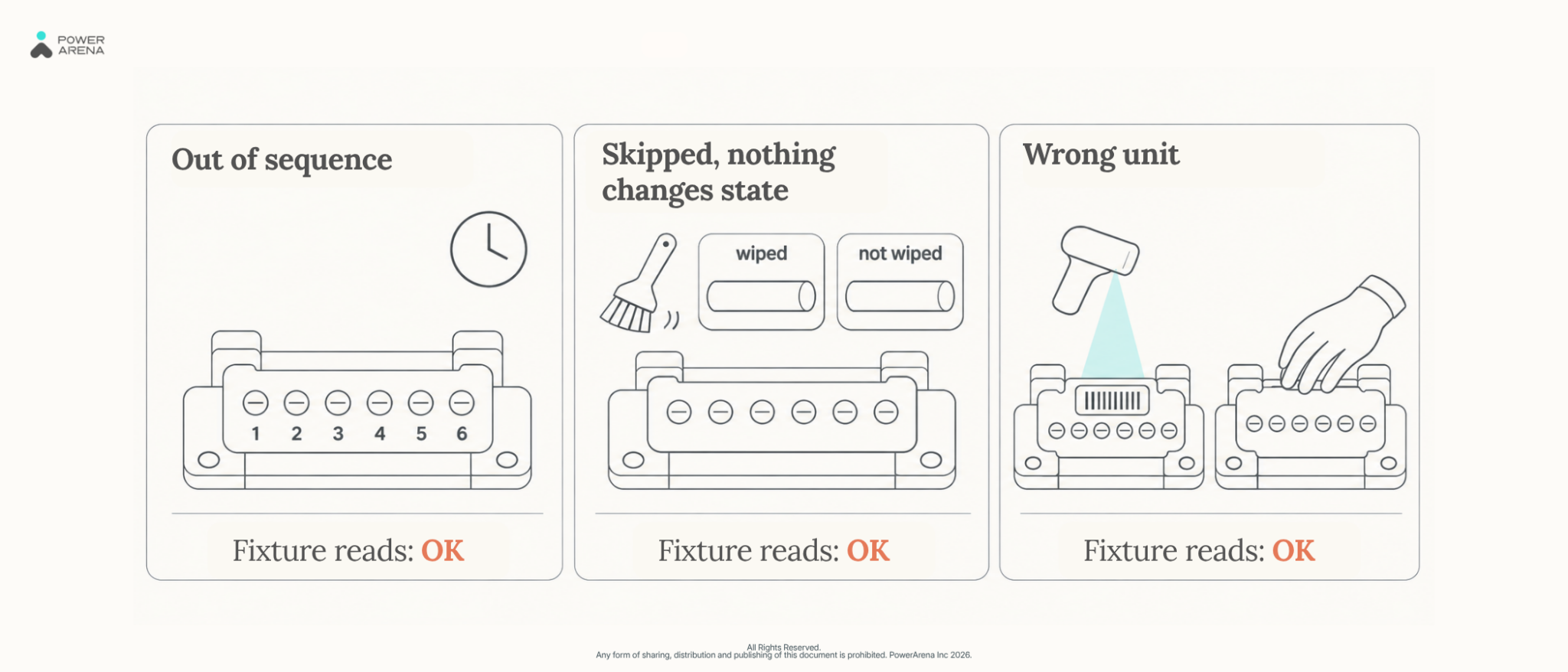
If a manual mistake leaves no physical trace, traditional mistake-proofing fixtures cannot detect it.
Digital poka-yoke: catching the missing action
The gap in all three is the same: there is no physical state to sense, so something has to watch the action instead of the object. That is what PowerArena HOP (Human Operation Platform) does. Cameras feed models trained on that station’s own sequence, and the trigger is not a part entering a fixture. It is a human movement: a hand reaching, a tool picked up, a brush applied.
What sets it off. The observed sequence is compared against the reference for that model: a step missing, a step out of order, an unspecified tool in hand, one half of a two-person sequence left incomplete. Back to the bracket: the operator drives four screws and reaches for the next unit, the count of driving actions does not reach six, and the cycle is flagged.
What the operator sees. An alert at the station, on a screen or an andon light, naming the step that is missing rather than a general fault. On high-risk steps the station holds the unit until that step is done, which turns detection back into prevention.
How fast. Inside the cycle, while the unit is still clamped and the operator’s hands are on it. The benchmark here is not milliseconds. It is whether the unit has left the station, because that one boundary decides everything about what the response costs you.
What record it leaves. A per-step entry indexed to serial number, work order, station, shift and timestamp, with the video sitting behind it. So when a complaint arrives naming one unit, you pull that unit’s assembly instead of reconstructing it from memory. It also lets FMEA work from observed failure modes, rather than remembered ones.
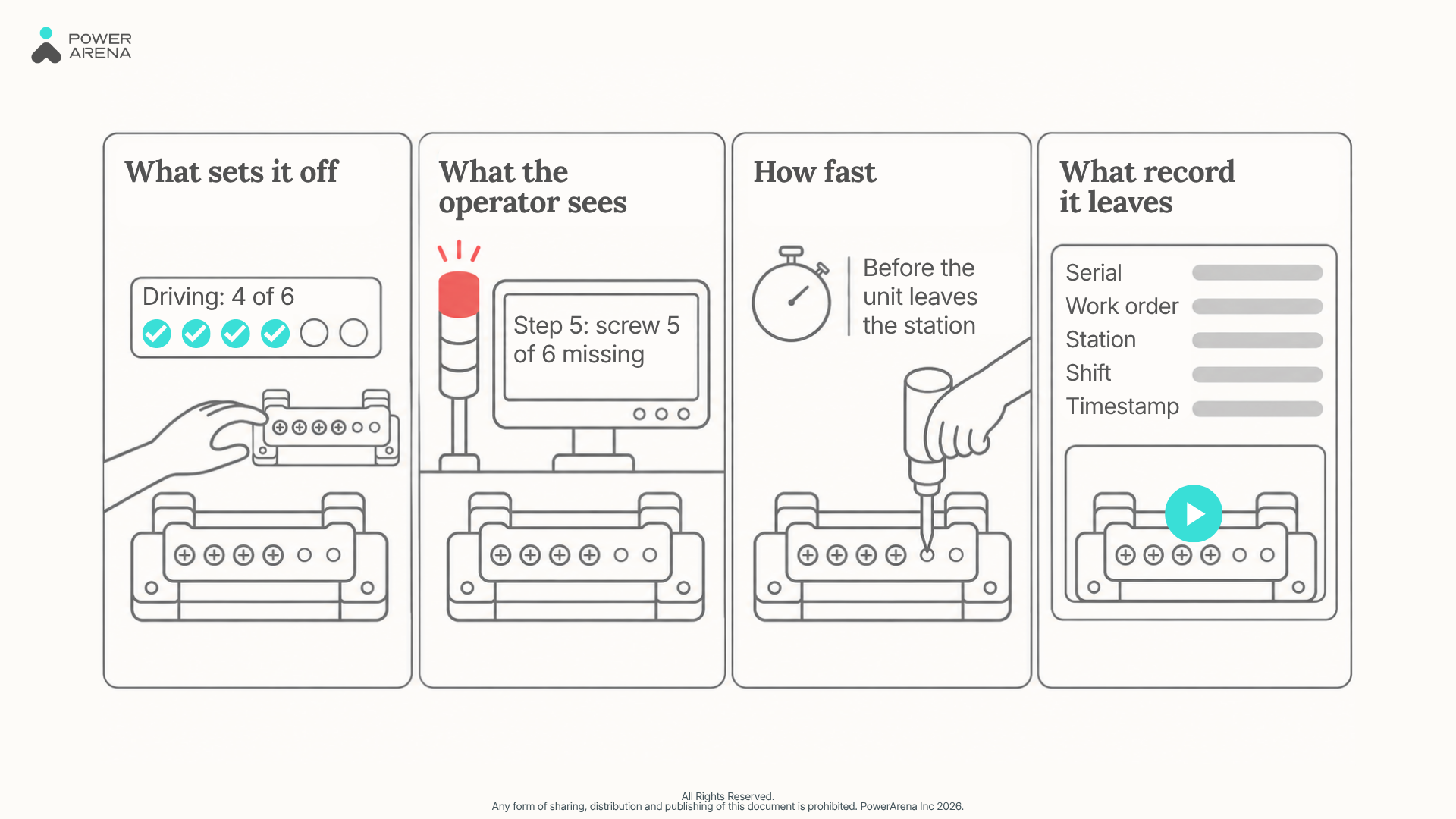
AI action recognition catches missing steps in real-time before the unit ever leaves the station.
Poka-yoke software does not replace the fixtures, and it is not meant to. The pins, the keying and the torque monitoring stay exactly where they are. The vision layer, HOP AI Poka-Yoke, covers the steps they were never able to reach.
Case: an EV manufacturer’s poka-yoke station
A global EV manufacturer had the fixtures, the torque tools and the process logging a modern line is supposed to have, and quality issues kept surfacing after shipment anyway. The steps causing them were manual actions performed inside a chassis that closed three stations later, so by the time anyone could look, there was no surface left to inspect and nowhere to mount a sensor. AI vision went in as the poka-yoke at that station, checking each operator’s action sequence against the SOP and holding the unit whenever a step was missing. First pass yield at that station reached 100%. A semiconductor reticle box line runs the same approach and holds 97.6% first pass yield.
Implementation checklist: six steps to mistake-proof a station
- Mark every step at that station sensed or un-sensed. Sensed means an existing device, log or downstream test would catch it if somebody skipped it. Walk the station and do this on paper first.
- Rank the un-sensed steps by what they cost when they are missed. A missed wipe that becomes a field return outranks a cosmetic step you could instrument tomorrow.
- Try prevention first on every one of them. If keying, geometry or a fixture change makes the error physically impossible, do that and stop. It is cheaper than anything else on this list.
- Define “done” for the rest as an observable action. Which hand, which tool, which order, and what marks it complete. If you cannot describe it, nothing can check it.
- Decide what happens when the alert fires. The operator corrects it in place, the station holds the unit, the supervisor is paged. Settle this before the install, not after the first false positive.
- Record the baseline first. Whatever that station already reports, keep reporting it for a month before anything changes. A mistake-proofing project with no before is, in the end, an anecdote.
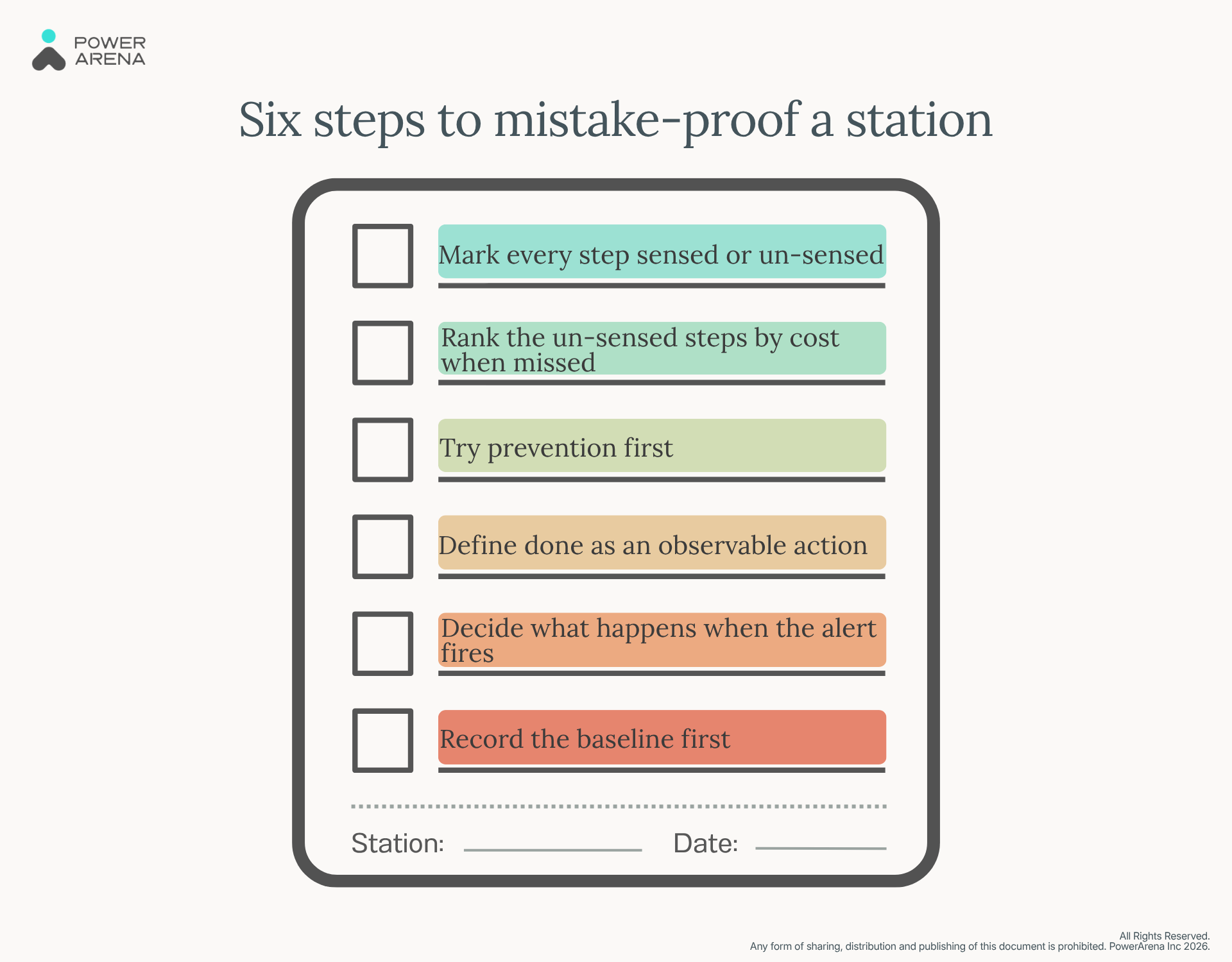
Use this six-step checklist to identify hidden vulnerabilities and mistake-proof your manual assembly stations.
FAQ
What is poka-yoke?
A mistake-proofing technique that designs the process or the equipment so a human error either cannot happen at all, or is caught the moment it does. It runs from a two-pin fixture costing almost nothing, up to a vision system checking a whole action sequence.
Who invented poka-yoke?
Shigeo Shingo, the industrial engineer behind much of the Toyota Production System, formalized it in the 60s. He used the term baka-yoke, fool-proofing, first, and changed it after an operator took offense (baka means idiot in Japanese).
What are the three types of poka-yoke?
Contact, fixed value and motion step. Contact devices sense shape, size, position or color. Fixed-value devices count parts or actions. Motion-step devices enforce the order the steps happen in.
What is the difference between poka-yoke and jidoka?
Jidoka is the broader principle that a process stops by itself when something abnormal happens, so that no defect passes downstream. Poka-yoke is one of the mechanisms that makes jidoka work at a single step.
Can a poka-yoke system work without sensors?
Yes, and in most factories the best ones already do. Asymmetric pins, keyed connectors, kitted trays and color-coded bins have no electronics in them at all. Sensors and vision come in for the steps that leave no physical state to design against.
Where to take this next
Twelve devices, three errors they share, and one checklist. If you want to go one layer deeper on the part that matters at your station, these are the places to start.
Related reading
- SOP compliance in manufacturing: how to measure it, not just document it. The skipped-step problem from the other side: what it takes to verify a step that leaves no mark.
- Does AI vision enhance FMEA?. What the per-unit record is worth once it exists: failure modes you observed rather than remembered.
- What the Anker recall reveals about process quality control and traceability. A recall traced back to the station, and what traceability would have changed.
Case studies
- AI vision creates an EV manufacturer’s future production line. The full version of the 100% first pass yield story: what the MES could not see, and what changed at the station.
- Semiconductor manufacturer improves product quality with HOP AI Poka-Yoke. The 97.6% first pass yield line: a 10 to 30 step reticle box station, mistake-proofed by action rather than by fixture.
See it at your own station
The fastest way to find out which steps nothing is checking is to walk one station with the six-step card in hand. We are happy to do the walk with you.
Book a walkthrough of your station: find out which steps nothing is currently checking
Table of Contents