❓What is SOP compliance?
SOP compliance is the degree to which operators perform a documented standard operating procedure (SOP) exactly as written, on every unit, every shift. A documented SOP proves the procedure exists. A followed SOP proves the work happened. Most quality systems measure the first and infer the second, and the gap between them is where your defects get built.
On the line, a nine-step SOP with a 45-second cycle time. The operator brushes lubricant onto a shaft, pushes a connector home until the latch clicks, checks an orientation, drives two screws, and hands the unit down the line. At the end of the shift, a sign-off sheet says all nine steps were performed on all 640 units, somebody initials it, and it goes in the folder for the audit in November.
Nobody is lying on that sheet. However, nobody watched 640 units either. Nobody could.
A 2021 study in Applied Sciences classified 59 error modes across three critical manual assembly tasks and found that 36 of them, 61%, were action errors: the step happened, but in the wrong order, with the wrong part, or in a way that left no trace. Not knowledge failures. Not missing documents. Errors in the doing. (Torres, Nadeau and Landau, Applied Sciences, 2021)
If you manage a line, you already knew that. The problem is proving it to anyone else, starting with the auditor who arrives in November.
📖 This article covers:
-
- What SOP compliance means once you separate documented from performed
- The four places compliance programs fail, in every factory, in the same order
- Four ways to verify adherence, compared on coverage, latency, evidence and cost
- How an EV manufacturer reached 100% first pass yield at its poka-yoke station
What SOP compliance actually means, once you separate what was written from what was done
In any factory, an SOP passes through four states, and quality teams routinely treat them as one.
- Documented. The procedure is written, versioned and controlled. This is what a document management system measures, and it measures it well.
- Trained. The operator has been taken through the procedure and can repeat it back to you.
- Acknowledged. The operator has signed, clicked, or passed a quiz confirming they read the current revision.
- Performed. The operator executed all nine steps, in sequence, with the specified tools, on this unit, the one with the serial number on it.
Of the four, though, only the last one touches the product. The first three make the fourth more likely, which is worth something, but they are not the same thing. When a report says 98% SOP compliance, in most factories it is reporting on states one to three, because those are the states that leave records behind. Counting what leaves a record, and calling the total compliance.
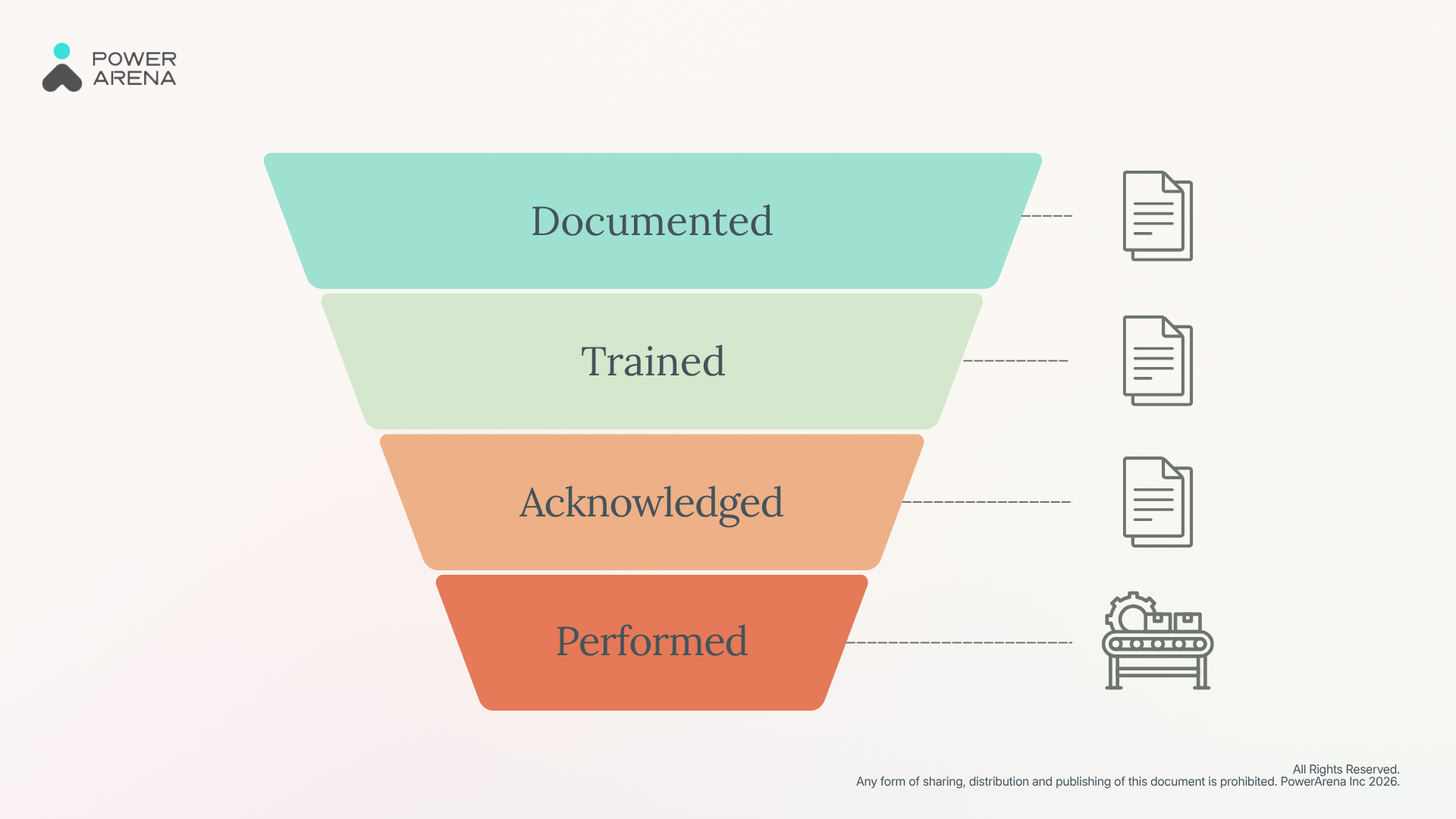
The four stages of SOP compliance
Why SOP compliance programs fail in the same four places
None of these are failures of effort. Each one is a sensible method meeting the limit of what it can see.
The SOP is written for the auditor, not the operator
On paper, a document that satisfies ISO clause structure and a document that fits on a screen above a 45-second station are not the same document. So the controlled SOP, fourteen pages of it in this example, stays on the server, somebody laminates a one-page summary for the station, and the two drift apart one revision at a time: revision 4 changes a torque value, the server copy gets it, the laminated card does not. The audit reads the fourteen pages. Your operator follows the card.
Acknowledgment is recorded, execution is not
On the reporting side, read receipts, e-signatures and quiz scores produce clean, exportable data, which is exactly why programs lean on them. They tell you an operator intended to comply on the day they clicked. However, they tell you nothing about the unit in front of that operator at 03:40, in week three of a new model ramp.
Audits sample minutes and infer months
On the floor, you can be at one station at a time. On a fifteen-station line, fourteen stations are unobserved while you are standing at the fifteenth. Adherence generally climbs when you are there and settles back when you walk away, which is how attention works in repetitive jobs and not a mark against anyone on your floor. So sampling a few minutes a week and reporting a monthly rate is inference, not measurement. It has been standing in for measurement for a long time because nothing better was affordable.
Deviations surface at end of line, after the unit is built
By the time an end-of-line check or a functional test flags something, the housing is closed, the adhesive has cured, and the operator who built that unit has built another 300 or so the same way. Then the real clock starts. McKinsey’s 2026 survey of automotive quality leaders found it takes roughly seven weeks from an issue being reported to a confirmed root cause, and another nine to ten weeks to get a countermeasure onto the line. (McKinsey, June 2026)
Four months, for a step that took four seconds. The units built in between do not wait for the root cause, they ship. Maybe a warranty claim brings one back, maybe nothing ever does and you never learn which step it was.
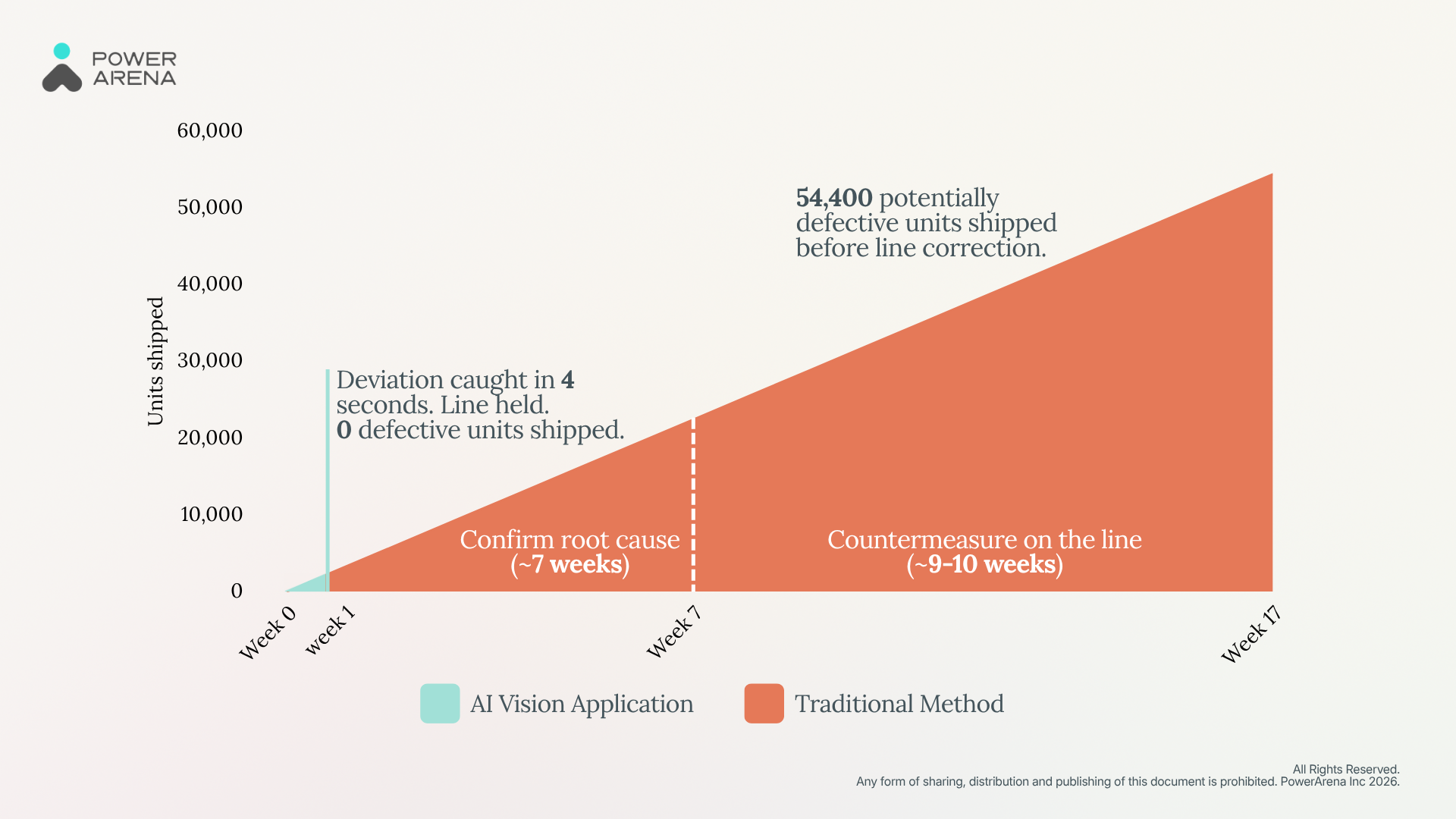
The hidden cost of delayed SOP correction cycles
Four ways to verify SOP adherence, compared on what each one was built to prove
| Method | Coverage | Latency | Evidence it produces | Cost per station |
| Sign-off sheet or e-signature | Every unit, none of the actions | End of order or end of shift | A name and a timestamp | Close to zero, paid in operator time |
| Supervisor spot audit | Minutes per station per week | Hours to days | An auditor’s written observation | No capital, high supervisor time |
| Video sampling with manual review | Whatever a reviewer has time to watch | Days, and only when someone goes looking | Footage, if the clip can be found | Cameras plus review labor |
| Continuous AI vision | Every unit, every station, every shift | Seconds, at the station | A per-step record indexed to serial number | Cameras plus platform, per station |
Each of the first three answers a real question, just not the one you are usually asking. A signature answers who was responsible. A spot audit answers what was happening while you watched. Video sampling answers what happened, if you already suspect something and know roughly where to look.
None of them, however, answers this:
“Was step 4 performed on unit 1183, the unit your customer just called about”
What continuous verification was built to do at the station
At the station itself, this is where PowerArena HOP (Human Operation Platform) sits. It does not replace your MES (Manufacturing Execution System), your IoT tools or your AOI (Automated Optical Inspection), and anyone who tells you otherwise has not looked at your line. It covers what those systems cannot see: a brush laying lubricant onto a shaft, a hand seating a gasket into its groove, a cloth wiping a contact surface before the cover closes over it for good. A smart torque wrench logs torque. Nothing logs the brush.
Step recognition, checking the sequence rather than the part
At the station, cameras feed models trained on that station’s own SOP. The system compares each observed action against the required sequence: tool selection, component placement, fastening, application, orientation check. Coverage does not depend on anyone being present, which means the night shift is measured the same way as the day shift.
A real-time alert while the unit is still in front of the operator
When a step is skipped, performed out of order, or performed with the wrong tool, a hand driver picked up where the SOP calls for the torque driver, HOP flags it at the station within seconds. The andon light turns from green to red (an andon is the lamp or board that shows a station’s state at a glance), and the screen names the step that is missing rather than showing a general fault. The operator can still put it right in place, so nothing goes to rework and the line does not stop.
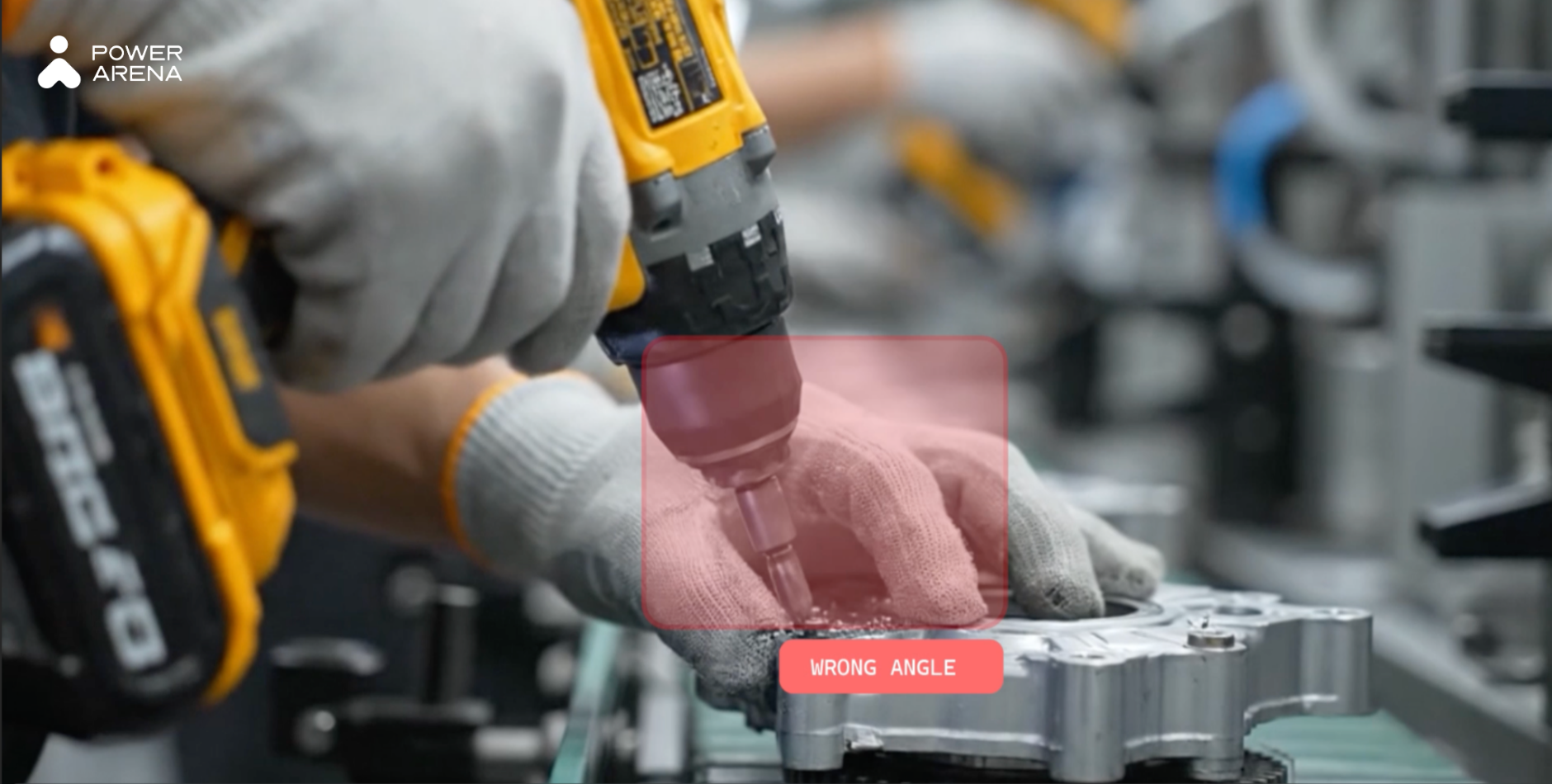
Per-step, per-shift traceability for the audit
Every station keeps a continuous record indexed to serial number, work order, timestamp and shift. So when a complaint arrives naming one unit, you pull the assembly footage for that unit in minutes, instead of opening an investigation by asking people what they remember about a Tuesday three weeks ago. MES records that a step was logged. Video records how it was done.
That is also the difference between telling a customer you follow the procedure and showing them.
Case: an EV manufacturer’s poka-yoke station
Before any camera went up, the questions this customer brought were the ordinary ones, the ones that come up once the easy automation is finished: “What’s the best way to track SOP compliance in real time?” and “How can I prevent defects before products leave the assembly line?”
They had already built what most people would call a smart factory. MES for process tracking, IoT-connected tools for parameter logging, AGVs (Automated Guided Vehicles, the carts that move material between stations with no driver) keeping material moving without delay. Early warranty issues kept appearing anyway, because several of the steps that mattered happened inside a chassis that got sealed three stations later.
- The gap. MES tracked equipment states and process parameters. However, it could not confirm that an operator had performed a manual step correctly, and at multi-operator stations it could not validate the two-person sequence as one thing.
- The change. AI vision went into the existing MES and AGV architecture as the behavioral confirmation layer. Steps that no IoT tool could verify were confirmed by camera at the moment they happened.
- The interlock. The AGV would not release a unit to the next station until vision confirmed the actions at the current one. So compliance stopped being something you monitor and became a condition of release.
- The result. First pass yield reached 100% at the poka-yoke station (poka-yoke is the Japanese term for mistake-proofing; first pass yield is the share of units that clear the station with no rework).
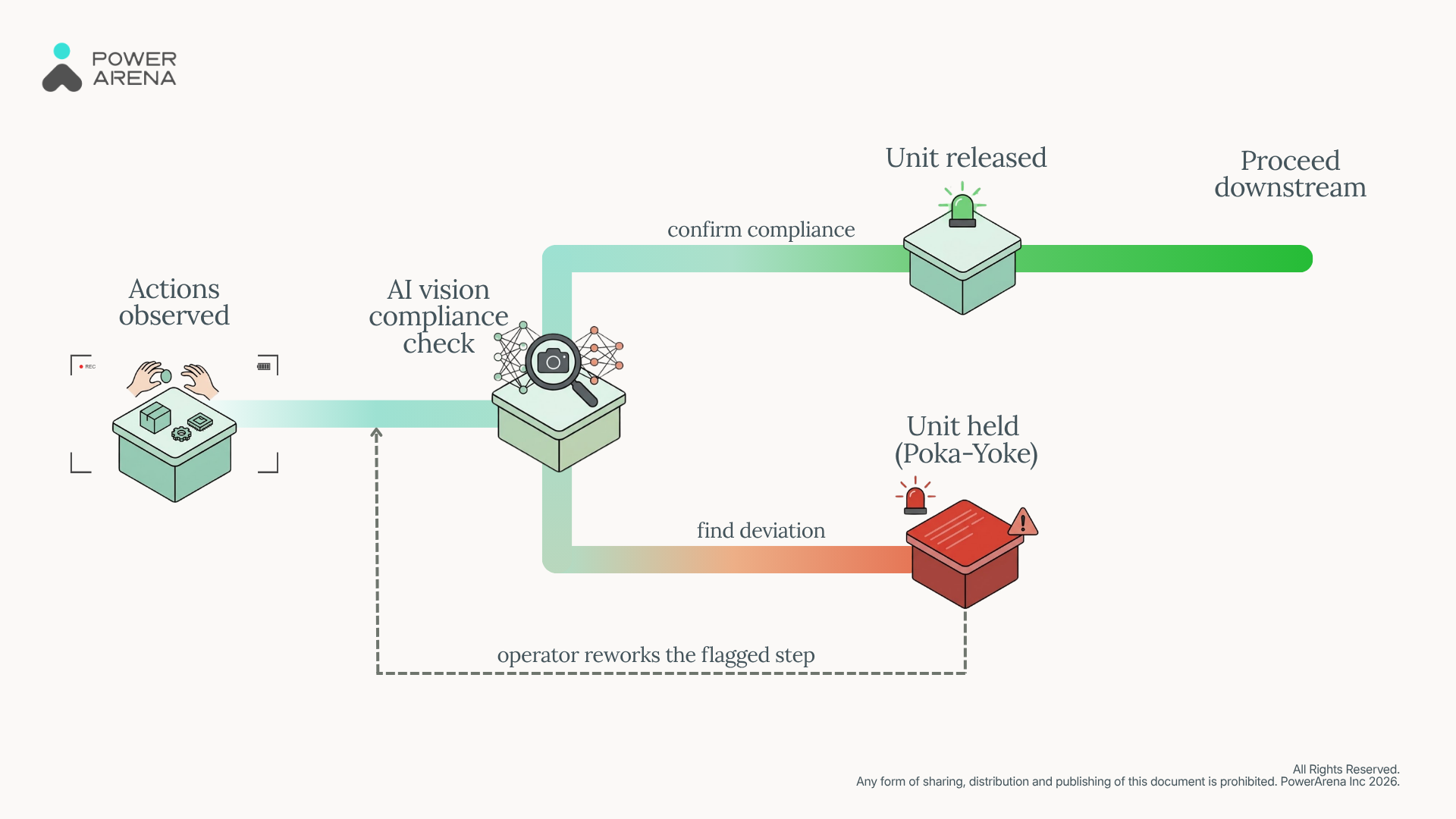
Poka-Yoke mechanism enabled by AI Vision
SOP compliance checklist: six things to confirm before your next audit
- The controlled SOP and the paper taped up at the station are the same revision. Check the station, not the server.
- You can name the steps in each SOP that no existing system can verify: no sensor, no log, no downstream test.
- Your compliance rate is calculated from observed execution, not from acknowledgments, and you can say which without looking it up.
- For any single serial number, you can produce evidence of how it was assembled, not just that it passed.
- Deviations get corrected at the station in seconds rather than caught at end of line in hours.
- Multi-operator stations are measured as one sequence, not as two step lists that happen to be next to each other.
If you can clear all six, your compliance number means what your customer thinks it means.
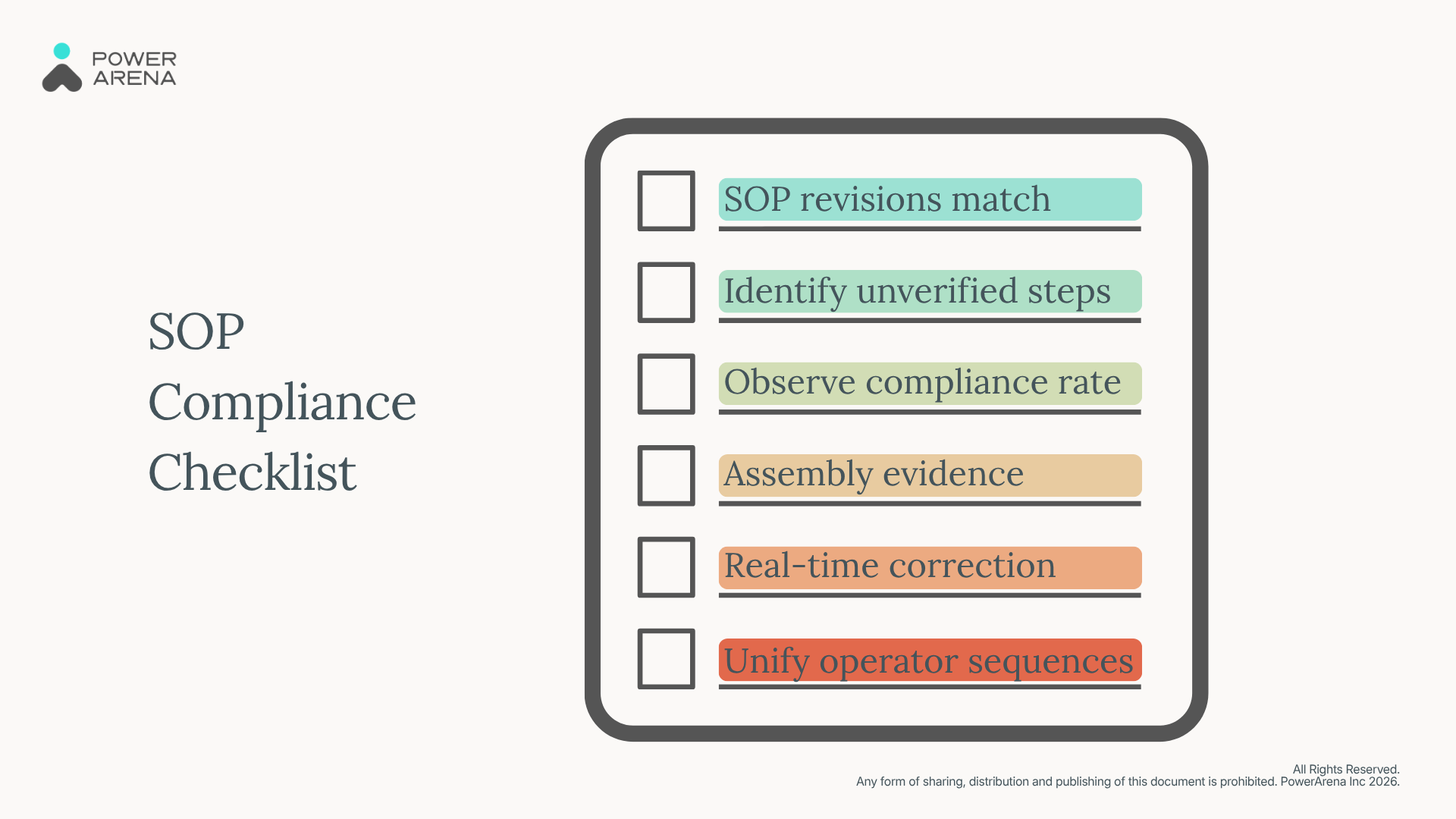
Key elements of an SOP Compliance Checklist
FAQ
What is SOP compliance?
SOP compliance is the extent to which operators perform a standard operating procedure (SOP) as written, on every unit. It is distinct from having an SOP, training on it, or acknowledging it. Only performance reaches the product.
How do you measure SOP compliance?
By observing execution rather than sampling paperwork. The four common methods are sign-off sheets, supervisor spot audits, video sampling and continuous AI vision. They differ mainly in coverage and in how long a deviation takes to surface.
What is a good SOP compliance rate?
Ask what the rate was measured from before you judge the number. A 98% built from signed acknowledgments and a 98% built from observed step execution on every unit describe two very different factories. Compare the method first, the percentage second.
What is the difference between an SOP and a work instruction?
An SOP describes the procedure for a process: scope, responsibility, sequence. A work instruction describes how one task inside it is performed at one station. Neither document proves the step happened.
How is SOP compliance audited?
Traditionally through document review plus floor observation on a sampling basis. That confirms procedures exist and that observed work matched them during the audit window. Continuous verification changes the evidence base from a sample to a record.
Where to take this next
Related reading
- What the Anker recall reveals about process quality control and traceability shows what happens when a manual step cannot be traced back to a serial number after the product is already in the field.
- Does AI vision enhance FMEA? is the next question if your failure mode analysis keeps scoring detection on tests that only run at end of line.
- How does AI vision upgrade quality management? widens the frame from one station’s SOP to the quality system that has to report on all of them.
Case studies
- AI vision on Gogoro’s human and machine collaboration line is the EV manufacturer above in full, including how the interlock was fitted to an existing MES and AGV setup.
- How a leading EV manufacturer built a traceable visual production history is worth reading if the part of this article you recognized was the customer complaint naming one serial number.
See it on your own line
If you want the checklist above answered with evidence rather than estimates, the module that does it is HOP AI Poka-Yoke, which verifies each step at the station and keeps the per-unit record the audit asks for.
See SOP compliance measured at the station:
Table of Contents