
❓SOP vs work instructions: what is the difference?
In the document stack above a station, an SOP describes a process: its scope, its sequence, and who is responsible. A work instruction describes one task inside that process, in the detail the person performing it needs. The SOP governs. The instruction executes. Neither document records whether the task was done.
| SOP | Work instruction | |
| Scope | A whole process, end to end | One task at one station |
| Audience | Quality, supervisors, auditors, engineering | The operator doing the job |
| Level of detail | What must happen, in what order, by whom | How to do it: tool, part, sequence, acceptance |
| Who owns it | Process or quality engineering, under document control | The manufacturing engineer for that station |
| Audited against | The quality system and the standard it is certified to | The SOP above it, and the product spec |
| Example | “Battery pack assembly, revision 7” | “Station 4: seat the connector, drive two screws, check the orientation mark” |
In most plants, the two documents live in different rooms. The work instruction is at the station: nine steps, taped to the bench at eye level, edges curling, one line highlighted by whoever worked there last. The SOP that governs it sits a corridor away, signed, current, unopened by anyone on that line. Both are doing their job. Neither is a record.

📖 This article covers:
- What each document is for, and where the line between them falls
- If/then rules for when you need both, and when the SOP alone is enough
- What digital work instructions change, and the one thing they leave open
- How an EV manufacturer reached 100% first pass yield at its poka-yoke station
What an SOP is, and what it was written to control
One level above the bench, an SOP, standard operating procedure, is the controlled description of how a process runs. It states the scope, who is responsible at each stage, the sequence of operations, the related documents and the revision history, and it changes only under control.
Its readership is wider than the floor: quality, a customer’s auditor, a new supervisor reading it to see what the line does. Most of them will never perform the process.
An SOP is therefore written at the level of the process, not the level of the hand. “Apply adhesive to the housing seam per WI-04” is an ordinary SOP line: what must happen, and where the detail lives. Pull that detail into the SOP and you get a document too long to use at a station, which means the operator stops opening it.
What a work instruction is, and what it was written to carry
At the station, a work instruction is the task-level document: one job, one person, written for the moment of doing. Manufacturing work instructions specify the tool, the part, the order of operations, the parameters and what a correct result looks like. In most instructions worth the name, the photographs and the short clips carry more of the meaning than the sentences do.
The constraint that shapes it is cycle time. At a station on a 45-second cycle nobody is reading a page. It gets read properly once, during training, and after that it works as a glance check, which is why it ends up taped where the eye already lands.
It also carries the training load: when a new hire takes the station on a Sunday night, the instruction stands in for the person who is not there to show them.
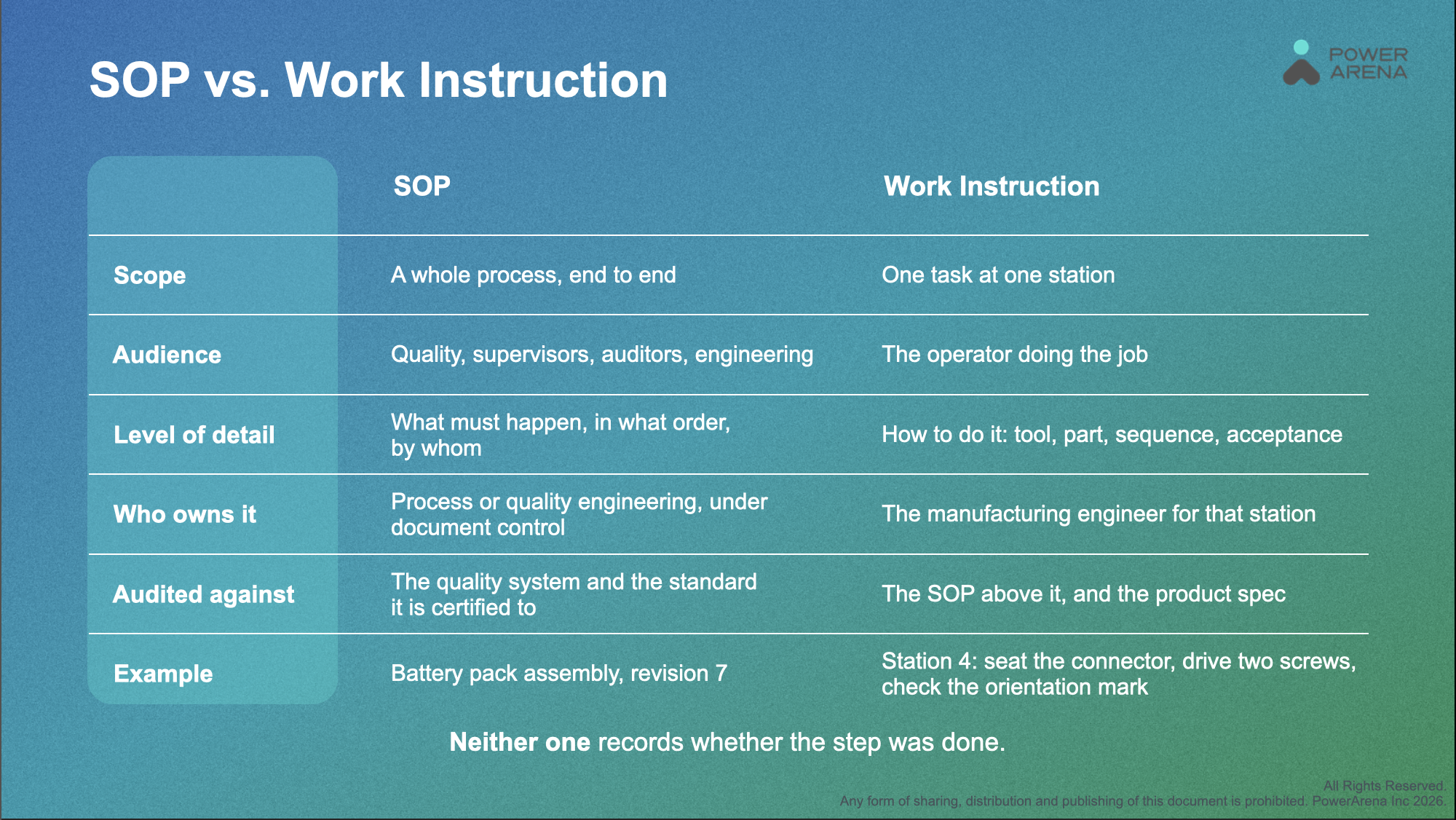
SOP vs work instruction, on one card.
SOP vs work instructions on your line: when you need both, and when the SOP alone is enough
On a factory floor the work instructions vs SOP question is a practical one: which tasks need a document of their own, and what has to sit above them.
If the process crosses stations, shifts or departments, you need an SOP above the instructions. Something has to define the handovers, and a station-level document cannot see past its own bench.
If a task takes more than a few steps and quality depends on their order, write a work instruction for it. Sequence is the thing an SOP compresses and an instruction preserves.
If a step becomes invisible after the next station, adhesive that disappears when the housing cover closes, a connector visible at station 4 and buried by station 6, it needs an instruction and a way to confirm it happened. Documentation alone leaves you no evidence and no second chance.
If operators rotate, or the line runs high mix (high mix means several models through the same station in one shift), both documents are carrying weight. The SOP holds the process steady while the instructions change with the model.
If the work is administrative, low volume, and performed by one qualified person, the SOP alone is enough. A work instruction for a monthly calibration record that one engineer has done for six years adds a document to control and nothing to the outcome.
If the SOP is your only document and the operator has never opened it, you do not have an SOP problem. You have a missing work instruction, and the operator has probably already written it themselves on a sticky note.
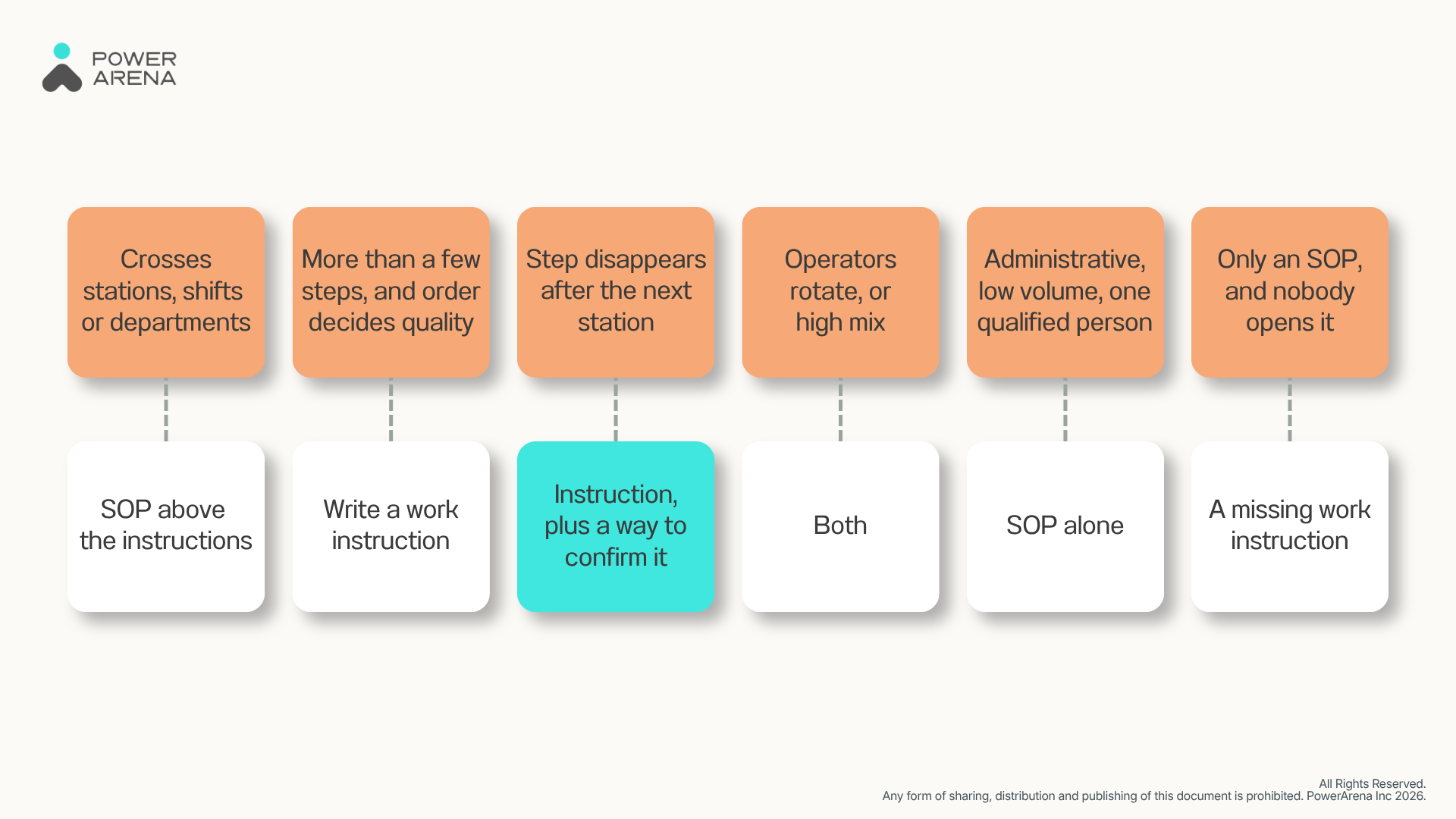
Six situations, six answers.
Digital work instructions: what changes and what does not
At the station, digital work instructions put the same content on a screen instead of on paper. Digital work instructions software is now its own category, and on the whole it delivers what it promises.
What digital was designed to fix: version control, media, sign-off
Version control is the strongest argument for it. One controlled source, one revision live at a time, pushed to every station at once. The laminated copy from two revisions ago comes off the wall the same afternoon.
Media is the second. Video of the correct motion, an annotated photo showing the connector before it seats and after it latches, a 3D view that rotates. On lines running in two or three languages, and in this region a good share do, the instruction switches language without a translation project.
Sign-off is the third. The operator confirms the step, the system timestamps it, and the record exports cleanly for the audit. Distribution, legibility and revision drift were real problems on paper, and this fixes them.
What stays unsolved: a signed-off step and a performed step are not the same record
Product pages in this category often carry a heading about improving SOP compliance. Read down for the sentence that explains how compliance gets confirmed. Most of the time it is not there, and nobody is hiding anything. The only evidence the system can hold is a click: step 4 turned from open to green because somebody pressed a button on the screen beside the bench.
A click is a good signal of intent and a weak record of the work. It tells you the current revision reached the right person and that they said yes. It does not tell you that the adhesive went on, that step 4 came before step 5, or that the driver in hand was the one the instruction names.
A document control system proves the instruction reached the operator. It does not prove the instruction was followed, and that limit sits in the format itself, not in anybody’s code. So when a complaint arrives naming one serial number, what you can hand your customer is a signature, not the work. Documents describe. They do not watch.
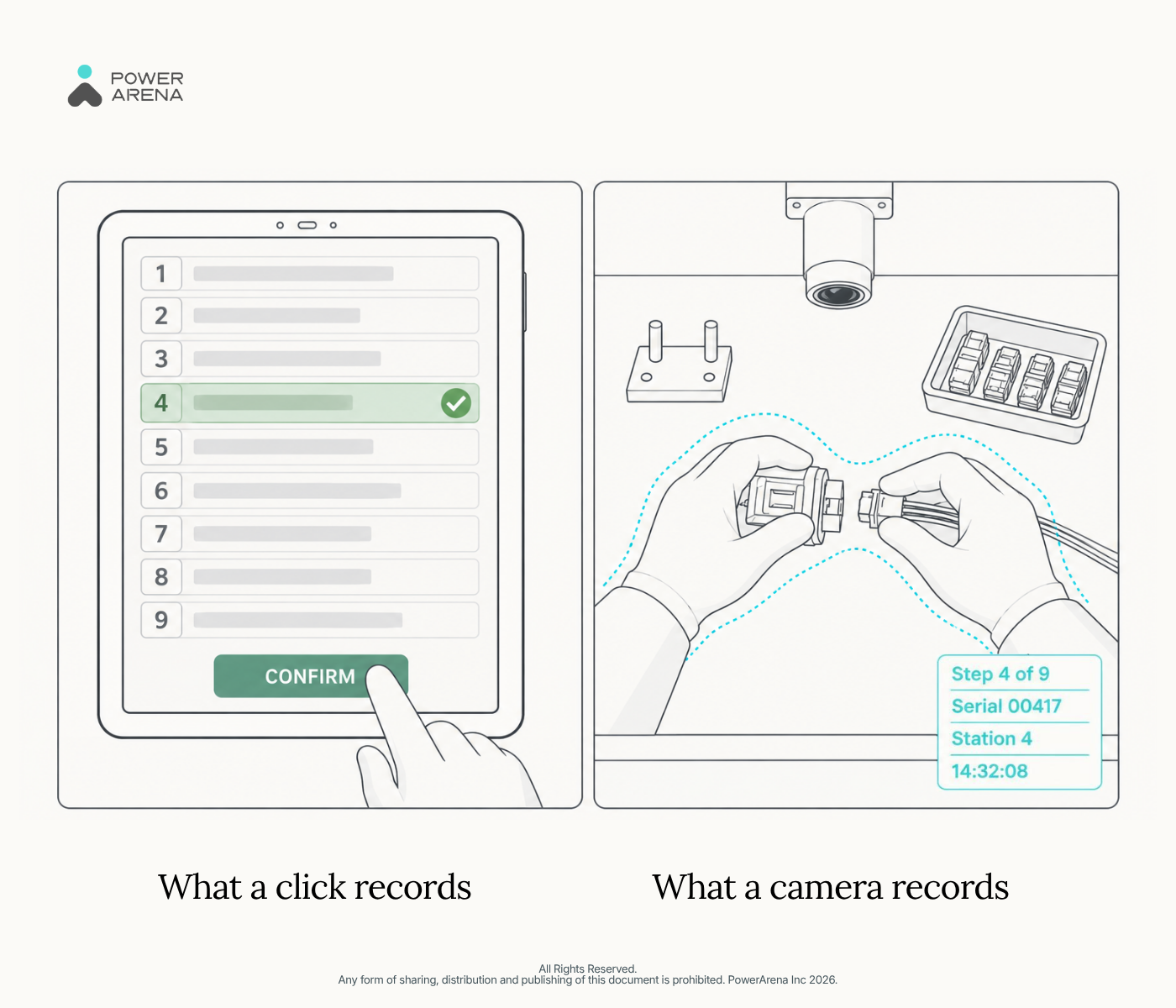
What a click records, what a camera records.
Closing the loop: verifying the instruction was followed
Once the document is current and in front of the right person, the question left over is verification: comparing what was done against what the instruction specifies, on every unit rather than on a sample. That is a longer subject than this one, and SOP compliance in manufacturing: how to measure it, not just document it covers it in full, comparing the methods on coverage, latency, evidence and cost. If verification is the part you came for, read that one.
The short version. At the station, PowerArena HOP (Human Operation Platform) puts cameras on the work and compares each observed action against the sequence the work instruction defines. The AI Poka-Yoke module (poka-yoke is Japanese for mistake-proofing) flags a missed step, a wrong order or an unspecified tool within seconds, while the unit is still in front of the operator. What it writes is not a signature. It is a per-step account indexed to serial number, station, shift and time.
The instruction still tells the operator what to do. Something else has to record what happened.
Case: an EV manufacturer’s poka-yoke station
At one global EV manufacturer, every assembly station had current, signed-off work instructions, and nobody had a complaint about the documents. The steps that decided quality were manual ones performed inside a chassis that closed a few stations later, so the only trace they left was an acknowledgment that the instruction had been read. AI vision confirmed each of those actions as it happened and flagged the ones that did not match, while the unit was still in front of the operator. First pass yield reached 100% at the poka-yoke station (first pass yield is the share of units that pass with no rework).
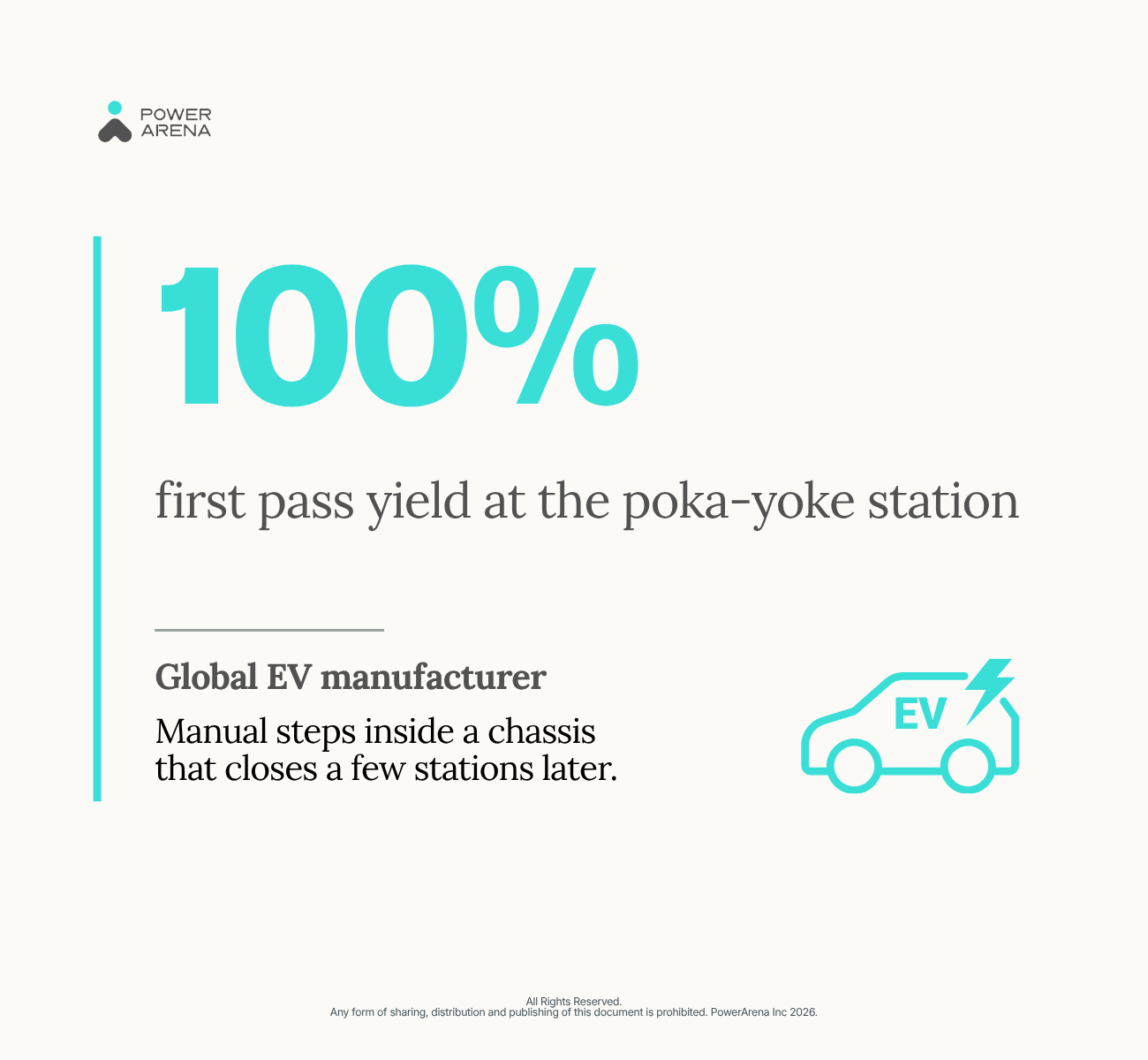
One number from the poka-yoke station.
FAQ
What is the difference between an SOP and a work instruction?
An SOP describes a whole process: who is responsible at each stage, and in what order the stages run. A work instruction describes how one task inside it is performed at one station, in operator-level detail. The SOP governs. The instruction operates.
Which comes first, the SOP or the work instruction?
The SOP, in principle: it defines the process and the boundary of each task, and the instructions fill those boundaries. In practice, plenty of factories inherit the instructions first, from whoever set the line up, and write the SOP around them, which works just fine as long as the SOP ends up governing rather than describing.
Do you need both for ISO 9001?
Not under those names. ISO 9001:2015 asks for the documented information the standard itself requires, plus whatever the organization determines is necessary for its quality management system to be effective, and it notes that the extent differs with organization size, process complexity and people’s competence (clause 7.5.1). Neither “SOP” nor “work instruction” is a mandated title. Your auditor asks whether the process is controlled and the documented information current and available where it is used. One note for your document schedule: the sixth edition of ISO 9001 is under publication, expected September 2026 (ISO).
What are digital work instructions?
Work instructions delivered on a screen at the station from one controlled source, usually with photos or video, step navigation, language versions and an electronic confirmation. They solve distribution, revision control and legibility. They do not observe the work.
How do you prove a work instruction was followed?
By recording execution rather than acknowledgment. A signature or a click records that an operator engaged with the document. Proof that the task was performed as written means observing the task itself, on every unit, and writing the result to a record you can pull up by serial number later. On manual assembly, continuous AI vision is the practical way to get that record.
Where to take this next
Two documents, one table, and one gap that neither of them closes. If you want to go further on any part of it, these are the places to start.
Related reading
- SOP compliance in manufacturing: how to measure it, not just document it. The verification argument this article hands off: the available methods compared on coverage, latency, evidence and cost, with the per-step record described in detail.
- Does AI vision enhance FMEA?. Once execution is recorded rather than acknowledged, the detection column of your FMEA stops depending on end-of-line tests. This is the article on what that changes.
- What is HOP? 6 steps to ready your factory for AI deployment. If verification is going on next year’s plan, the six things to have ready before a camera goes on a station, starting with the work instruction itself.
Case studies
- AI vision creates an EV manufacturer’s production line for human-machine collaboration. The four-sentence case above in full: an MES that logged every machine and none of the manual steps, and how the poka-yoke station reached 100% first pass yield.
- How a leading EV manufacturer built a traceable visual production history. The other half of the record: station video tied to the product barcode and work order, so a complaint months later pulls up the footage for that unit instead of a signature, and new operators get the instruction on screen at the station.
See it at the station
If the per-step record the last FAQ describes is what you are missing, the module that writes it is HOP AI Poka-Yoke. It checks each action against the work instruction while the unit is still in front of the operator, and keeps the per-unit record an auditor or a customer will ask for.
Book a consultation to see a work instruction verified at the station:
Table of Contents