
By Sharon Hsieh
2026 Smart Factory Technologies
The year 2026 marks a turning point for global manufacturing. Rising production costs, shrinking engineering talent pools, supply chain volatility, and pressure to replicate “golden line” performance across regions have pushed factories to accelerate digital transformation.
Today, smart factory technology is no longer a futuristic vision. It’s the operating system of modern manufacturing. A smart factory integrates data, machines, people, and AI into one connected ecosystem that continuously learns, predicts, and optimizes itself.
Factories adopting the right combination of smart manufacturing technologies gain the ability to:
- Predict failures before they happen
- Detect quality issues in real time
- Maintain consistent output across different sites
- Scale production with fewer engineering bottlenecks
- Digitize and replicate best practices from their top-performing lines
1. Data Lakehouses: The Data Backbone of Smart Factories
A modern data lakehouse helps manufacturers bring all their information into one place, whether the source is an ERP system, video recordings, sensor logs, handwritten forms, or audio notes.
Instead of switching between scattered databases and spreadsheets, teams can finally work from a single, unified source of truth. Engineers gain real-time visibility into production behavior, supply chain teams can follow material movements as they happen, and AI models have clean and consistent data to learn from. With this foundation in place, factories can identify issues faster, compare line performance more easily, and build reliable AI-driven improvements.
2. Industrial Internet of Things (IIoT): Turning Machines Into Data Sources
IIoT makes the entire shop floor visible by allowing machines and tools to send meaningful data every second.
Once sensors, cameras, and smart tools are connected through a secure network, each piece of equipment becomes a source of insights.
Managers can check machine status instantly, maintenance teams receive early warnings when vibration or temperature shifts indicate wear, and inventory levels update automatically as materials move through stations. As a result, factories can act before problems escalate and shift from reactive fire-fighting to proactive decision-making.
Modern IIoT enables:
- Real-time machine data streaming
- Automated OEE tracking
- Predictive maintenance using edge AI
- Remote operations and asset monitoring
- Inventory tracking through sensors and RFID
- Machine-to-cloud communication for faster root-cause analysis
3. Artificial Intelligence & Machine Learning: The Decision Engine
AI and ML function as the analytical brain of a smart factory. These systems study large amounts of data from machine cycles, operator actions, and production outcomes.
They can uncover patterns that human teams may miss, such as early signs of equipment decay or subtle relationships between workstation setup and recurring defects. AI-driven scheduling tools can also reorganize production plans automatically when situations change. In environments with significant labor turnover, AI supports new operators and provides engineers with clear and actionable insights.
With labor turnover rising across Asia and the US, AI now acts as a digital co-pilot to engineers and production teams.
Scaling Golden Line with AI Vision in Southeast Asia
Within the broader field of AI, AI vision has become one of the most impactful technologies for modern smart factories. Especially for human-centric operations where traditional sensors or automation fall short.
AI vision enables factories to see, understand, and interpret the thousands of micro-interactions happening on the shop floor every day. More importantly, it transforms a category of information that was historically impossible to access or digitize. Such as the tacit operational knowledge embedded in human movements, workstation behavior, and the real sequence of production actions.
AI vision turns the hardest, most human parts of manufacturing into data you can analyze, improve, and scale.
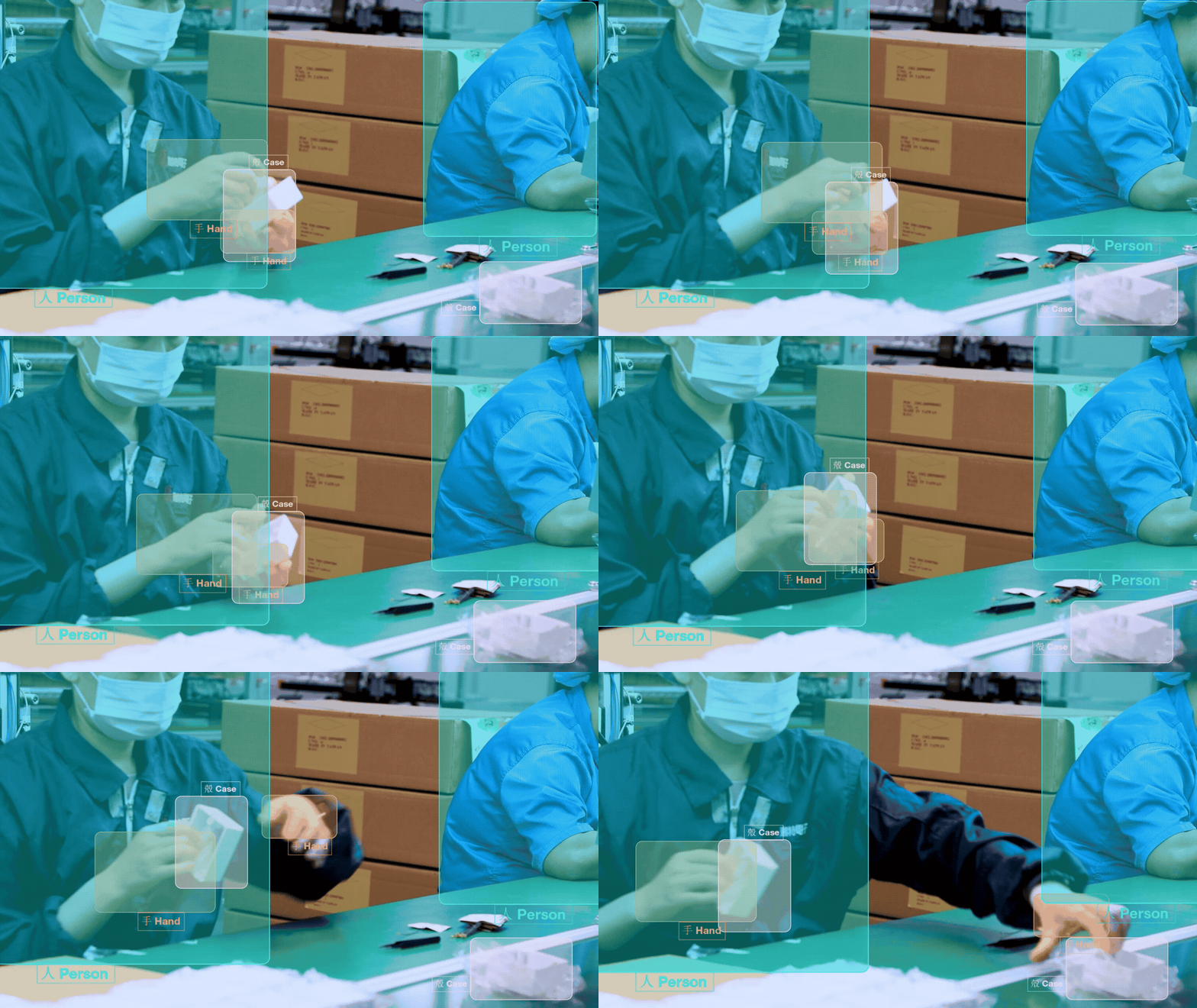
PowerArena’s AI vision accurately tracks operator actions and objects, ensuring full compliance with standard operating procedures (SOPs).
4. Anomaly Detection: The Nervous System of Preventive Manufacturing
Anomaly detection operates like a highly attentive expert who monitors the production floor every second. It examines time-based data from machines, such as cycle times, torque values, temperatures and vibration levels, and identifies when something begins to deviate from normal patterns.
Small shifts often reveal problems long before they become visible.
When the system spots unusual behavior, teams can intervene early to prevent breakdowns, quality failures, or productivity losses. This approach leads to more stable lines and significantly fewer surprises.
Instant Quality Alerts for Semiconductor Production Lines
5. Robotics & Automation: Precision, Safety, and Scalability
Robotics in 2026 serve as flexible partners across the production line. Robots take on tasks that require consistency, precision, or repetitive force, such as assembly, welding, and material movement.
They also create safer working conditions by handling high-risk or hazardous steps. When robots work together with AI vision, they become even more adaptable because they can recognize component types and orientations without needing detailed manual programming. Many advanced factories now combine robotics, IIoT data, and AI insights to build production cells that automatically adjust to changing demand, SKU variations, or shifts in quality performance.
6. Cloud & Edge Computing: The Infrastructure That Makes Real-Time Possible
Smart factories operate on both edge computing and cloud computing to achieve real-time intelligence.
Edge computing handles urgent decision-making directly on the shop floor. This allows the system to analyze sensor data within milliseconds, issue immediate warnings, and keep critical operations running even during network disruptions.
Cloud computing, on the other hand, supports long-term storage, complex AI model training, and collaboration between multiple factory sites. When both layers work together, factories can process massive data volumes quickly while continuing to develop deeper analysis and global benchmarking.
7. Digital Twins: Virtual Factories That Learn in Real Time
A digital twin is a virtual model that mirrors the exact state of a machine, workstation, or entire factory.
The twin updates itself through live IIoT data, which allows teams to experiment safely with different scenarios. They can test new staffing plans, layout adjustments, or production speeds without affecting the real line. The system can also identify upcoming bottlenecks and suggest improvements before performance drops. Engineers benefit from the ability to troubleshoot remotely, especially when they cannot be on-site. This leads to shorter ramp-up cycles and more predictable performance when launching new lines or products.
8. Predictive Analytics: From Data to Action
Predictive analytics brings together information from IIoT sensors, machine logs, vision systems, and ERP or MES platforms to highlight trends that matter most. Instead of relying on gut feeling, teams can see clear evidence of where improvement is needed.
For example, the system might show that quality issues always increase during specific shifts, or that scrap spikes whenever a certain supplier’s material is used. By turning patterns into actionable insights, factories can adjust maintenance timing, redesign processes, or train staff more effectively. This allows organizations to prevent issues instead of reacting to them after the fact.
Why Smart Factory Technology Matters in 2026
The global manufacturing landscape is undergoing restructuring. Supply chains are regionalizing, costs are rising, and product cycles are shortening. Factories can no longer rely on manual monitoring, tribal knowledge, or static processes.
Smart factory technology enables:
- Replication of “golden line” performance across countries
- Reduction of cost of poor quality
- Faster problem detection and preventive action
- Greater transparency for multi-site operations
- Lower engineering workload through AI-assisted analysis
- A more resilient and scalable production ecosystem
Manufacturers that integrate these technologies now will enjoy higher margins, stronger uptime, better yield, and more predictable operations, which are key advantages in a volatile market.
Table of Contents