❓What is automated visual inspection?
Automated visual inspection is the use of cameras and software to judge whether something meets a standard, without a person having to look. It splits three ways: rule-based systems that check parts against fixed criteria, learned systems trained on examples, and action-based systems that watch people at work.
On your desk, two quotes are open. Both say “AI-powered automated visual inspection”. Both demo videos show the same thing: a red box closing around a scratch on a brushed metal casing, then a green tick where the red box was, and a pass rate ticking upward in the corner of the screen.
One of the two will struggle in week three, when the new model arrives and the part sits in the fixture at a slightly different angle. The brochures do not say which one.
They cannot, really. One phrase is covering three different technologies, and the three fail in different places. The useful thing is to know which one is in front of you before the pilot starts, not after.
Kearney measured the part of the factory that almost none of these systems are pointed at. 72 percent of tasks in the factory are performed by humans, generating 71 percent of the value created by the operation, while “the tools used to measure human activity have remained effectively unchanged since 1908”. (Kearney, The State of Human Factory Analytics)
📖 This article covers:
-
- The three kinds of automated visual inspection, and what each one can and cannot detect
- Why the same phrase covers a fixed rule set and a trained model
- Which of the three questions your line is actually asking
- Six criteria to take into a vendor demo, with the red flag for each
- What changed on a semiconductor reticle box assembly station, and the numbers it moved
Automated visual inspection: rule-based, learned, and action-based
Every system sold under this name is one of three things. Work out which one is in front of you before you compare prices. They are not substitutes for each other.
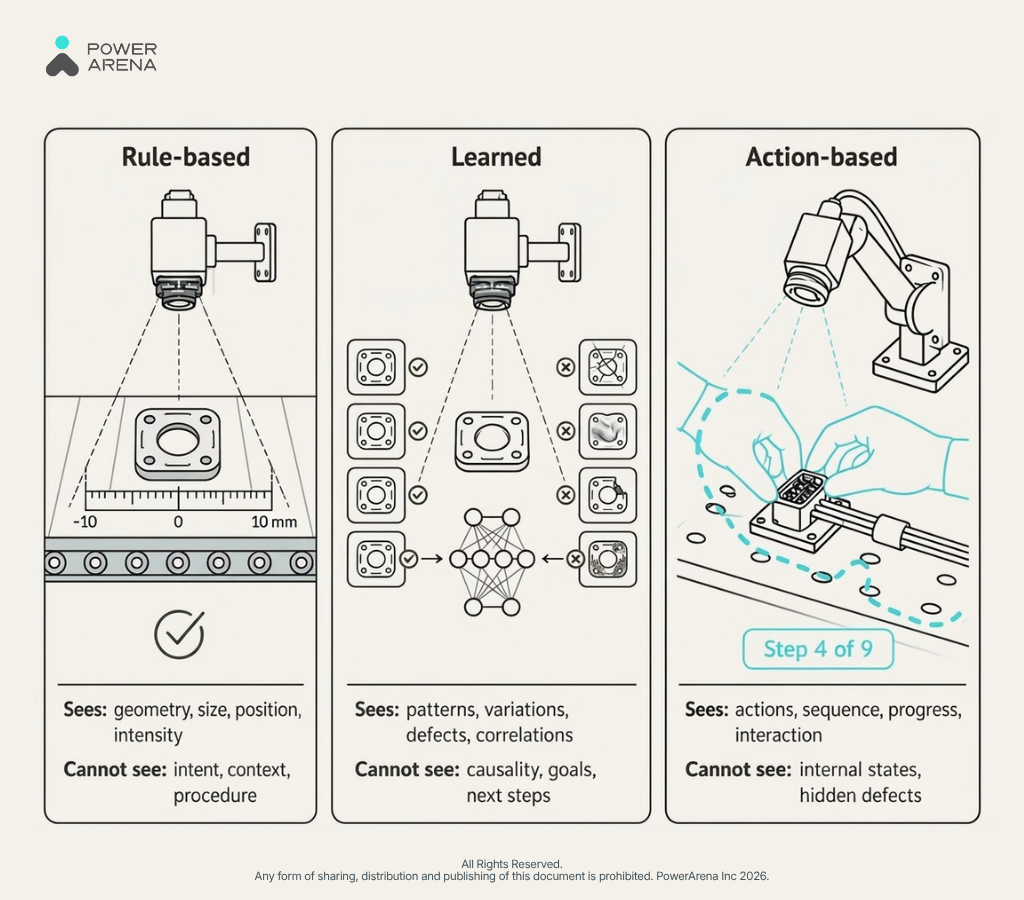
Comparison of rule-based, learned, and action-based inspection capabilities.
1. Rule-based inspection (traditional machine vision): built to judge a known part
Industrial cameras, controlled lighting and pre-programmed algorithms compare an object against fixed criteria and return pass or fail at high speed.
The system does not learn. It does not adapt. It does exactly what it was configured to do, in the conditions it was configured for. That is both its strength and its ceiling.
Where it works well:
- Surface defect detection (AOI, automated optical inspection): scratches, cracks, contamination, missing components on finished products
- Dimensional measurement: geometric tolerances to micron level
- Position guidance: directing robotic arms and pick-and-place systems to exact coordinates
Where it stops is anything it was not told about. Your supplier switches the casing from silver to gray, the same scratch stops registering as a defect, and nothing on the line announces the change. On a stable, high-volume line running one product, that ceiling may never be a problem. On a high-mix line, you will usually meet it during the first ramp (the run-up to full volume on a new model).
2. Learned inspection (deep learning on parts): built to tolerate variation
Models are trained on labeled images of good and defective units, so the system recognizes patterns it was never explicitly programmed to find. It tolerates variation in lighting, position and finish that would break a rule set, and it can be retrained when a new defect type appears.
The cost sits in the data. Somebody has to collect and label enough defective examples, and rare defects are rare precisely when you need them most. Ask a vendor how many labeled images the model needs before it is production-ready, and who does the labeling. If the answer is “we handle that”, ask what happens when your product changes in November.
Both of these categories inspect one thing: the part, after it exists.
3. Action-based inspection (AI vision on operators): built to watch the sequence
Here the object under the camera is not a part. It is a person performing a sequence.
Instead of judging a finished item, the system recognizes actions and compares them against the SOP (standard operating procedure): whether the torque driver was picked up rather than the manual screwdriver next to it, whether the component was turned the right way round before it was seated, whether step 4 happened before step 5, whether the operator paused for eleven seconds waiting for a fixture. The trigger is a human action, not a part arriving in a frame.
This is the layer PowerArena HOP (Human Operation Platform) works on. HOP recognizes parts and tools at the point of use, tracks operator motion against the required sequence, measures cycle time at every station continuously, and links footage to serial number, timestamp and station ID so any unit can be replayed later.
At a reticle box assembly station, where a single operator may be responsible for 10 to 30 steps, a global semiconductor manufacturer with more than 25 years in precision components put it to work. Cycle time fell from 3.5 minutes to 2.8 minutes, UPH (units per hour) rose 19 percent, and first pass yield reached 97.6 percent. Their industrial engineer described the change in a way no spec sheet does: “We used to rely on experience to identify issues. Now, with video and data, we pinpoint bottlenecks and justify improvements with confidence.”

Results of deploying action-based AI inspection on a complex manual assembly station.
Part of the gain came from work that happened before any model was trained. Defining part placements, tool positions, and left and right hand assignments made the AI recognition possible. It also made the process better on its own. PowerArena’s fundamental model, the base action recognition model behind this, has delivered a 32.3 percent productivity improvement.
Which question your line is actually asking
Each category answers one question well and the other two badly.
“Did this part come out right?” Rule-based inspection, on a stable product, where it works just fine. This is usually the cheapest answer per unit, and it is mature technology.
“Did this part come out right, when the part varies a lot?” Learned inspection. You pay for the data and the retraining, and you get tolerance for variation in return.
“Was this unit built correctly, and can I prove it?” Action-based inspection. Nothing that looks at the finished part can answer this, because most of what you want to verify was sealed inside the product three stations before it reached the camera.
Many factories that already run AOI are asking the third question while shopping in the first category. That mismatch is what the six criteria below are there to catch, early and cheaply.
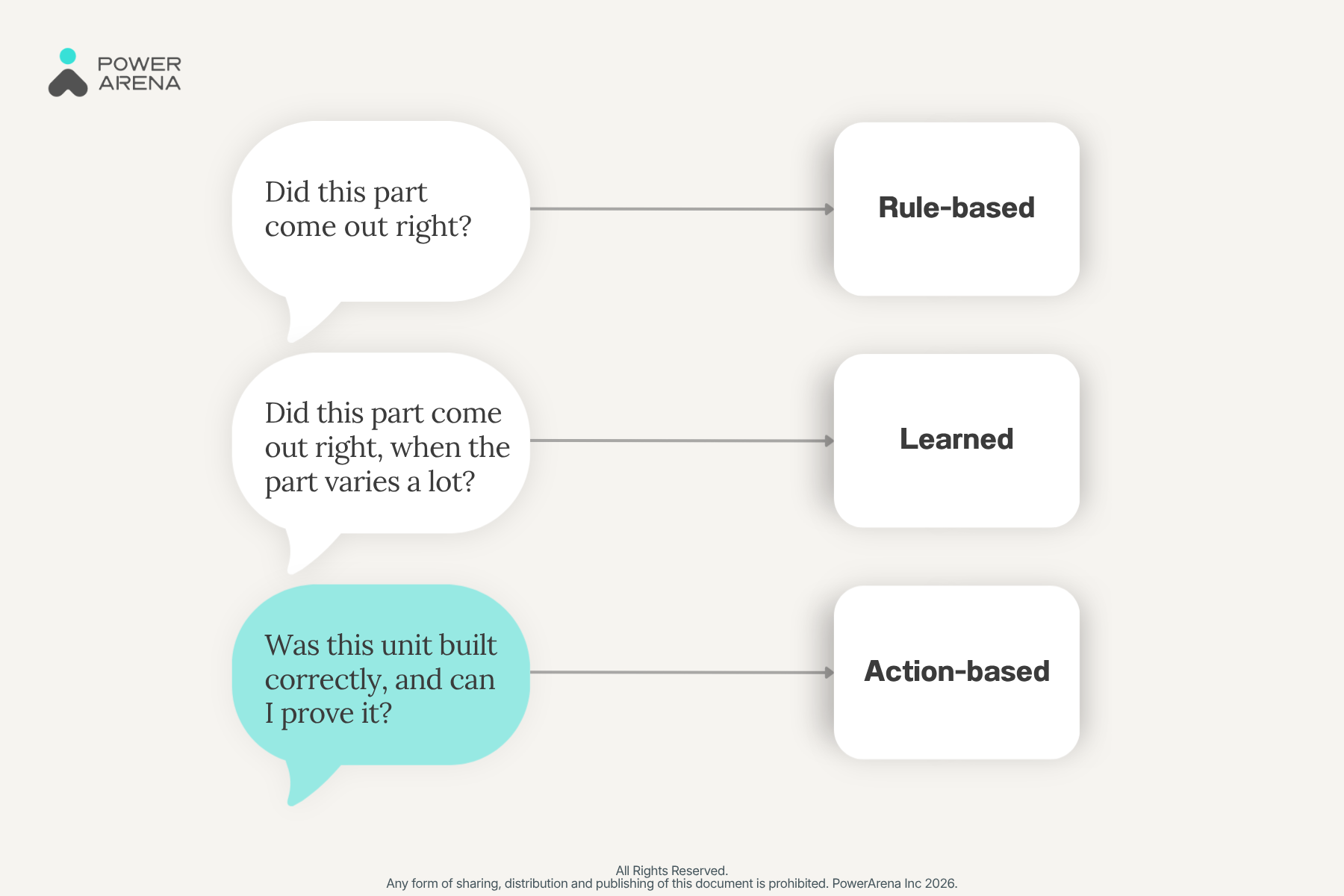
Matching the exact question your production line is asking to the right inspection technology.
Six criteria to take into the demo: what to demand, and the red flag
Take this table into the demo with you. These are ordinary questions for anyone who has deployed inspection before, and a vendor who has done it will have answers ready for all six.
| Criterion | What to demand | Red flag |
| 1. What the camera is pointed at | A clear statement of the object under inspection: the part, or the action. Ask them to name it in one sentence. | “Both” with no separate explanation of how actions are recognized. Part inspection and action recognition are different models. |
| 2. Behavior under variation | A demo on your parts, including a rotated, differently lit, or off-color sample you supplied yourself. Ask what the screen does when a part that has just passed is turned 15 degrees and run again. | A demo only on the vendor’s own golden samples (their known-good units, lit and placed to suit the system), or a request for “representative conditions” before they will show you anything. |
| 3. Training data and who owns it | The number of labeled examples needed to reach production accuracy, who labels them, how long that takes, and who owns the trained model and the footage afterwards. | No number. “It learns automatically” is not an answer, and neither is a figure quoted without a defect type attached to it. |
| 4. Latency and where the alert lands | Alert time in seconds, and a named recipient: the operator at the station, the line leader, or a shift report. Then ask what that person is expected to do in the next 30 seconds. | Alerts that arrive in a dashboard nobody has open, or a daily summary email described as “real time”. |
| 5. The evidence it produces | A per-unit record indexed to serial number, station and timestamp, retrievable in minutes during a customer complaint. Ask to watch one unit pulled up live, not a screenshot of one. | Pass and fail counts only. Aggregate charts with no way back to a single unit. |
| 6. Cost of change | A written answer on what happens at the next model changeover: what is reconfigured, by whom, how many days of line access, and what it costs. | “Minimal reconfiguration required.” Ask for the number of days. A vendor who has deployed before knows it. |
The two rows most likely to decide whether this works are 4 and 6. Rows 1 to 3 sort out what the system can see. Rows 4 and 6 decide whether it is still switched on a year later, after the pilot is over and the engineer who set it up has moved on.
What to take into the next vendor conversation
Bring your own defective parts to the demo. Not a description of them. The parts.
Name the station before you name the technology, and say why that station. If a vendor never asks which one, that tells you something about how they scope.
Write down, in one line each, the three things you cannot verify at that station today. If a vendor cannot say which of the three their system covers, assume it covers one.
Ask who has already run this on manual assembly, and ask to speak to them without the vendor on the call. How that request is handled will tell you more than the demo did.
And ask what happens on the third shift, when nobody senior is on the floor. You will feel a little blunt asking it. Ask anyway.
If you are evaluating action-based systems specifically, HOP Digital Station is where the cycle time, step verification and video recall capabilities described above sit.
FAQ
What is automated visual inspection?
Automated visual inspection uses cameras and software to check whether something meets a defined standard, without a person inspecting it. It covers three distinct approaches: rule-based systems checking parts against fixed criteria, learned systems trained on labeled images, and action-based systems that recognize what an operator is doing at a station.
What is the difference between machine vision and AI visual inspection?
Machine vision applies programmed rules to an object in a controlled position and returns pass or fail. AI visual inspection learns from examples instead of rules, which lets it tolerate variation and, in the action-based case, recognize sequences of human movement that no rule set can fully enumerate.
Can automated visual inspection detect assembly errors, not just defects?
Only the action-based kind can. Part inspection sees the result after the fact, so anything sealed inside the product before it reaches the camera is beyond it. Action recognition verifies the step at the moment it happens, while the unit is still in front of the operator.
How accurate is AI visual inspection?
Accuracy figures only mean something attached to a defect type, a lighting condition and a data set. Ask any vendor quoting a percentage what it was measured on, and ask to see the false positive rate alongside it. A system that flags too much tends to get switched off by the line leader inside a month.
Do I need to replace my AOI system?
Usually not. AOI at end of line and action-based inspection during the process answer different questions, and the usual architecture runs both: one checking what came out, the other recording how it was built.
Where to take this next
Three questions, three technologies, one table to take into the room. If you want to go one layer deeper on any of them, these are the places to start.
Related reading
- SOP compliance in manufacturing: how to measure it, not just document it. If action-based inspection is the category you are shopping in, this is the article on what “verified” actually means at a station.
- Does AI vision enhance FMEA?. What criterion 5, the evidence, is worth once it exists: failure modes you observed rather than remembered.
- How AI vision upgrades quality management. The wider QA and QC picture the three categories sit inside.
- Keeping yield at 95% with AI in semiconductor manufacturing. The yield side of the reticle box story above.
Case studies
- Semiconductor manufacturer improves product quality with HOP AI Poka-Yoke. The full reticle box deployment: the 10 to 30 step station, the SOP rewrite, and where the 3.5 to 2.8 minutes came from.
- Line balancing at a top-five EMS. Action-based inspection on a 15-station line, where the same cameras that verify steps also measure cycle time.
See it on your own line
The fastest way to settle which of the three your line needs is to pick one station and run the six questions against it. Bring the part.
Book a consultation to see automated visual inspection applied to manual assembly:
Table of Contents