
What is Quality Management?
Quality management is the set of activities a company runs to make sure its products or services meet customer requirements and regulatory standards, and keep meeting them. Whatever the industry, getting quality right is what earns customer trust, keeps operational risk down, and lets a business grow without surprises.
In manufacturing, that comes down to two things: parts that conform to spec, and a process that behaves the same way shift after shift.
As production gets more complex and multi-plant, multi-country operations become the norm, manufacturers are finding that the only way to keep quality management efficient is to move to more capable systems: ones that reduce headcount pressure, cut the dependence on veteran floor knowledge, and let teams act on quality in real time instead of after the fact.
“We went back and checked the [vehicle] warranty claims coming in from the field. What used to be a month’s worth of demand dropped to zero. We saw a clear effect within the first weeks of the [AI vision] rollout.” ── Director of Smart Manufacturing Systems and Solutions, electric vehicle and scooter manufacturer
3 Things Effective Quality Management Gets Right
1. Control quality in-process. Prevention beats inspection.
In-process quality control (IPQC) carries most of the weight in a manufacturing quality system. The principle is simple: find it early, fix it now. Catching a problem while it is still small and contained is worth far more than screening for it at final inspection, after it has had a chance to spread into finished goods.
“If you can catch a problem on the line and fix it on the spot, it costs almost nothing. Once that product is out in the market, the numbers get frightening.”
── Director of Smart Manufacturing Systems and Solutions, electric vehicle and scooter manufacturer
Case in point: a German luxury automaker’s recall
In 2022, a well-known German luxury automaker detected an internal anomaly in a braking system. The root cause traced back to a supplier’s manual assembly step: circuit boards were not properly cleaned, which degraded the brake system and put vehicle safety at risk.
Because the error was not caught at the process stage, the same defect stayed in production for two years. By the time it was contained, more than 1.5 million vehicles had been recalled, with repair and handling costs estimated at roughly €1 billion. Worse, management still could not confirm that every affected vehicle had been pulled back. Customer and dealer confidence dropped, the press and the market questioned the company’s quality control and supplier oversight, and the share price fell close to 28%.
—— Source: Bloomberg, September 16, 2024. https://www.bloomberg.com/news/articles/2024-09-15/bmw-took-two-years-to-find-extent-of-brakes-defect-that-hit-rolls-royce-sedans
What this case makes clear about in-process control and production records:
- A process control failure is expensive.
- Safety-critical industries carry more risk.
- Error-proofing the process is the lever.
- A production record is what makes accountability and traceability possible.
How does AI vision error-proof a production process?
2. Use a quality methodology to keep improving the process
3. Build a company-wide quality culture with TQM
5 Quality Management Methods
Structured, step-by-step methods help teams get to root cause faster, build improvement loops that can be tracked, and raise overall quality and yield.
1. PDCA cycle
PDCA stands for Plan, Do, Check, Act. The cycle was introduced in the 20th century by the American management thinker W. Edwards Deming as a systematic approach to quality management.

Use the PDCA cycle to keep improving the process and raising quality.
Each pass through the cycle builds on the results of the last one and sets the next target, until the quality goal is met.
2. FMEA (Failure Mode and Effects Analysis)
FMEA is a systematic, preventive tool used in both product design and process engineering. Its purpose is to identify potential failure modes before a plant commits to volume production, assess how each one would affect the product and the system, and rank them so the team knows what to fix first. The payoff is avoiding the costs that follow a defect into the field: recalls, warranty repairs, and brand damage.
3. CLCA (Closed-Loop Corrective Action)
CLCA is a closed-loop quality process built around four steps: identify the problem, trace the root cause, implement the fix, and verify that it worked. Dell was an early adopter, and the approach is now widely used across manufacturing. The point is to keep problems from coming back, so every incident gets resolved for good and leaves behind an improvement record the team can reuse.
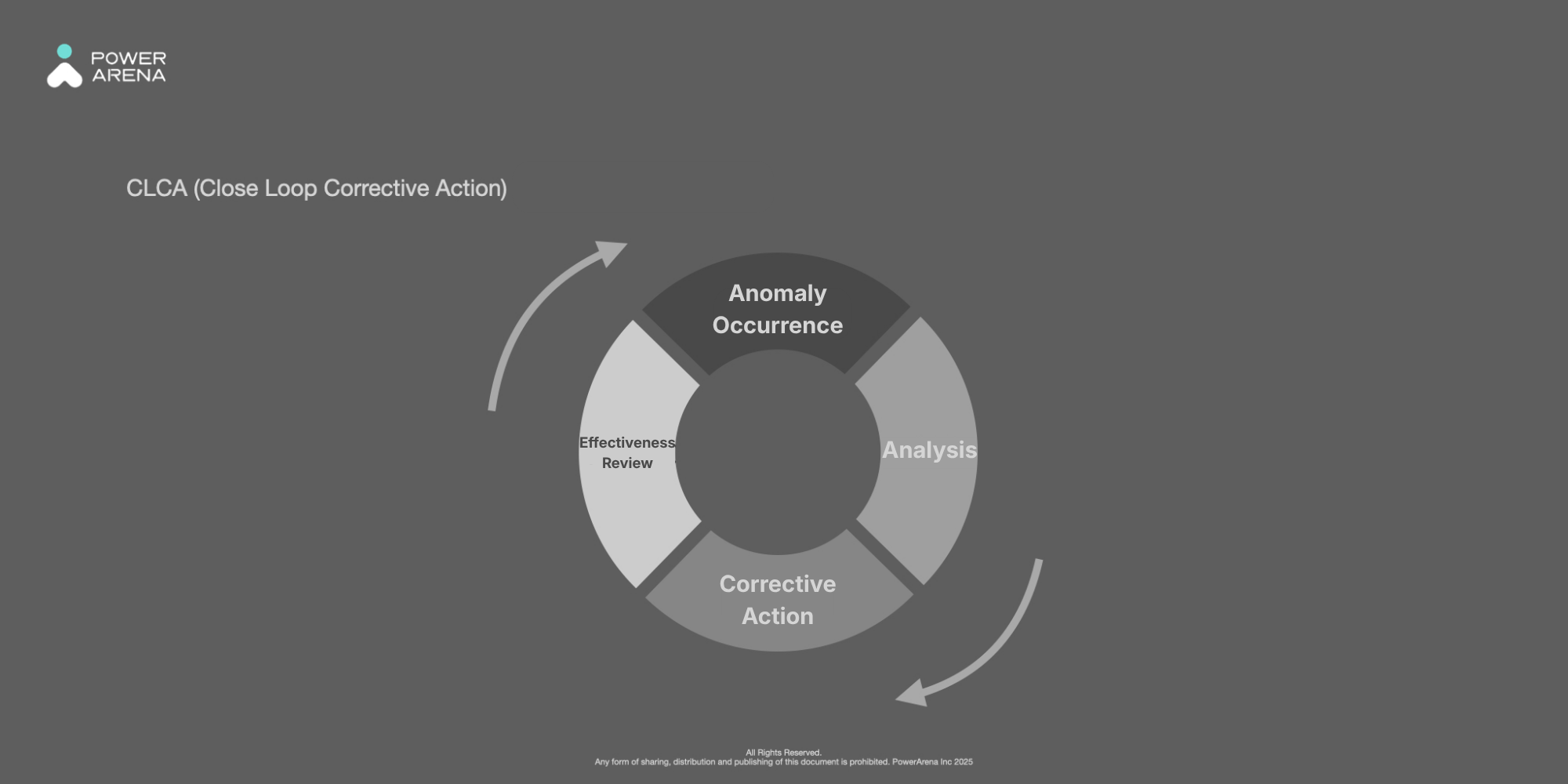
CLCA (Closed-Loop Corrective Action) process diagram
Here is what that looks like on a real line…
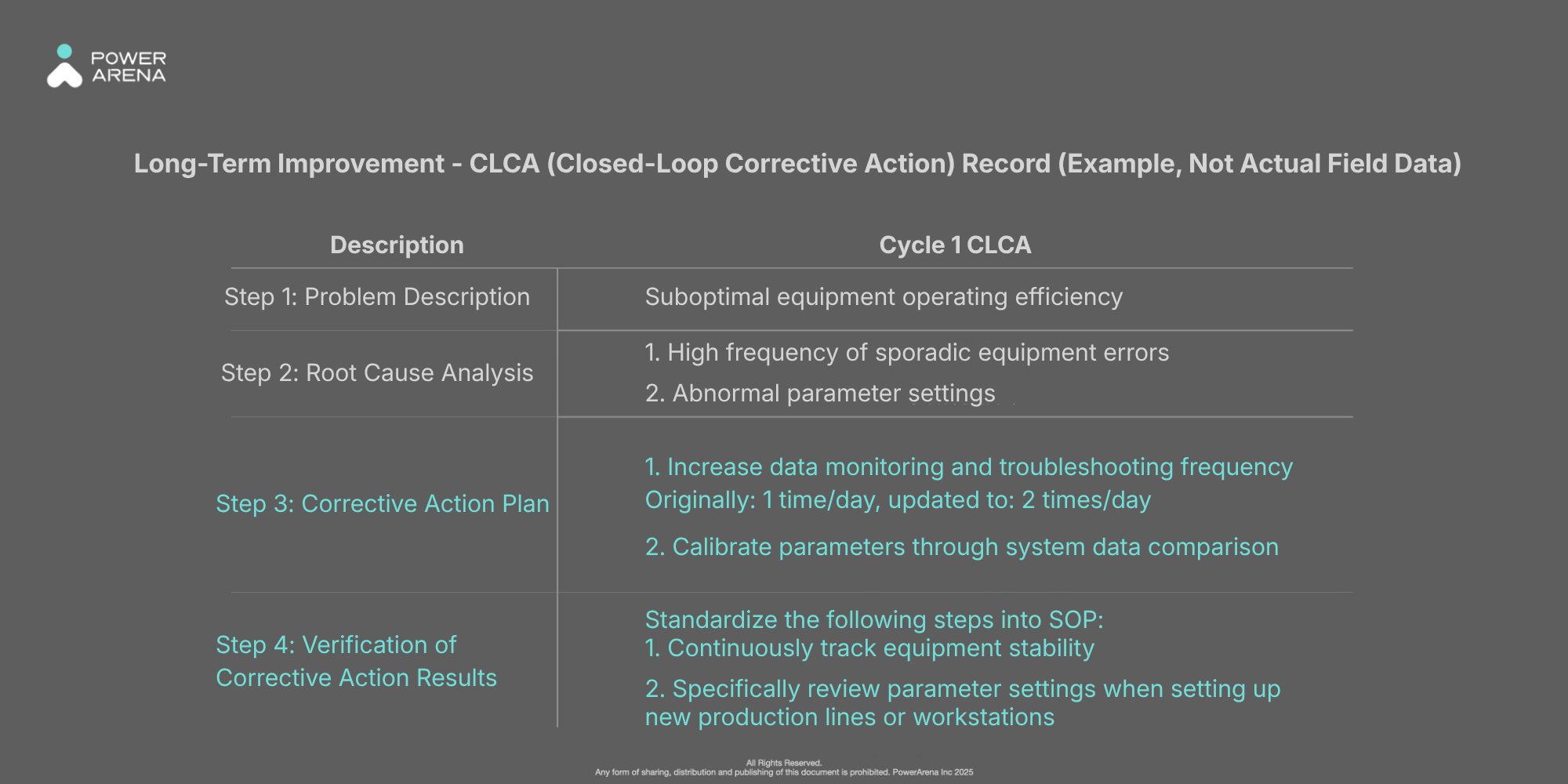
A plant uses the CLCA feature in HOP, the Human Operation Platform, to keep a complete record of line improvements.
4. Six Sigma
5. Quality management systems (such as ISO 9001)
Quality Roles in Manufacturing and What They Do
The quality function in a typical manufacturing organization breaks down into these roles:
- Quality Assurance (QA)
- Quality Control (QC)
- In-Process Quality Engineer (QE)
- Supplier Quality Engineer (SQE)
- Quality Data and Systems (QMS / Data Analyst)
As factories digitize, larger companies are adding dedicated quality data analysts and QMS administrators. They maintain the internal quality management system, pull inspection data from the floor into one place, and turn it into analysis and dashboards that give leadership a factual basis for decisions.
Analysts with a technical background may go a step further and take part in building and deploying AI models, for example quality prediction models or early-warning systems for anomalies.
5 Quality Management Problems Manufacturers Run Into
1. Work instructions exist, but they are not followed
Most lines have documented SOPs. The problem is that many of them were written without accounting for how operators actually work, the constraints of the physical environment, or the variation that shows up in a real process. So the SOP exists on paper but is only partly followed in practice, and product quality takes the hit.
Even plants that have deployed production management systems run into the same gap: those systems are good at collecting equipment-level data, but they generally cannot see what is happening in manual operations as it happens.

HOP, the Human Operation Platform, collects and analyzes production data automatically and uses AI vision to build error-proofing into the process.
2. Defects are hard to catch at the moment they happen
On many lines, a defect that is not caught at the station where it occurs gets covered up by the next station’s parts or assembly. By then it is hard to find at inspection, and it often surfaces only as a customer complaint.
High turnover makes this worse. New operators who are still learning the process are the most likely to introduce variation, and even with more training, a line supervisor cannot watch every operator’s every step.
When experienced and new operators are mixed on the same line, both throughput and quality tend to suffer. Relying on final inspection to screen out bad parts means more rework, more scrap, and higher total cost of production.
HOP, the Human Operation Platform, uses AI vision to track operator actions in real time and confirm that each step matches the SOP. Cameras on the line record the entire process and, more importantly, judge in the moment whether an action has drifted from standard and flag it as it happens.

HOP uses AI vision to track operator motion and report SOP deviations as they occur.
Need automated in-process error-proofing?
3. Production data is incomplete and hard to analyze
Under a traditional model, industrial engineers spend a lot of hours observing and recording by hand. That method cannot cover every shift, and it misses the non-value-added activity that matters most: operators stepping away from the station, gaps between operations, and similar losses. Small as these look, they are what drive efficiency and quality outcomes.
Without complete, real-time process data, quality management is not grounded in what actually happened on the line. Anomalies are found late, traceability of quality issues weakens, and product consistency and overall production stability suffer.

HOP (Human Operation Platform)
What is HOP? Advantages and applications in one place
4. No complete production record for traceability
Many plants still record data by hand. Without a system that ties together video, data, and root-cause tracking, they cannot quickly reconstruct what happened when an anomaly or a customer complaint comes in.
Brand owners are now paying closer attention to production traceability and process transparency. A contract manufacturer that cannot produce a clear production record for a product risks losing the brand’s confidence in its quality control. A complete production record is the foundation for tracing quality issues, and increasingly a condition for keeping the account.
5. Management know-how does not transfer or get tracked
Geopolitics has pushed manufacturers with long-established operations in China to diversify where they build, for supply chain flexibility and resilience. Southeast Asia’s location and labor cost have made it the default destination.
Compared with mature bases in China and Taiwan, these companies are finding that new plants in Vietnam and Thailand run 20% to 30% behind on quality and efficiency…

Quality Management Success Stories
AI vision error-proofing during production
In-process quality control that ties together AGV, MES, and AI vision
This well-known motorcycle brand has invested heavily in smart factory deployment in recent years. Its first error-proofing layer was built on MES and AGVs.
As volume grew, the plant found that MES could not trace how operators actually performed assembly, and SOP deviations were still getting through…
“Even with a digital SOP, you still cannot be sure people are following it.” ── Director of Smart Manufacturing Systems and Solutions, electric vehicle and scooter manufacturer
LLM automation for production and quality control
Production control staff used to query line data through SQL and similar database syntax. It was slow and tedious, and a bad query or a poorly designed table could produce wrong readings and skewed decisions. The data in the system was also often incomplete or stale, so even after hours of analysis it did not necessarily reflect what the line was doing right now…
Conclusion
1. Bring shop floor information into one place
In a traditional electronics plant, departments use different management methods and record data at different times, which makes improvement meetings hard to focus.
“When we review production with management, every department has a different read on the situation and a different fix. If the system gave me objective data, I could get to the right fix quickly.”
—— Vietnamese industrial engineer, major electronics manufacturer
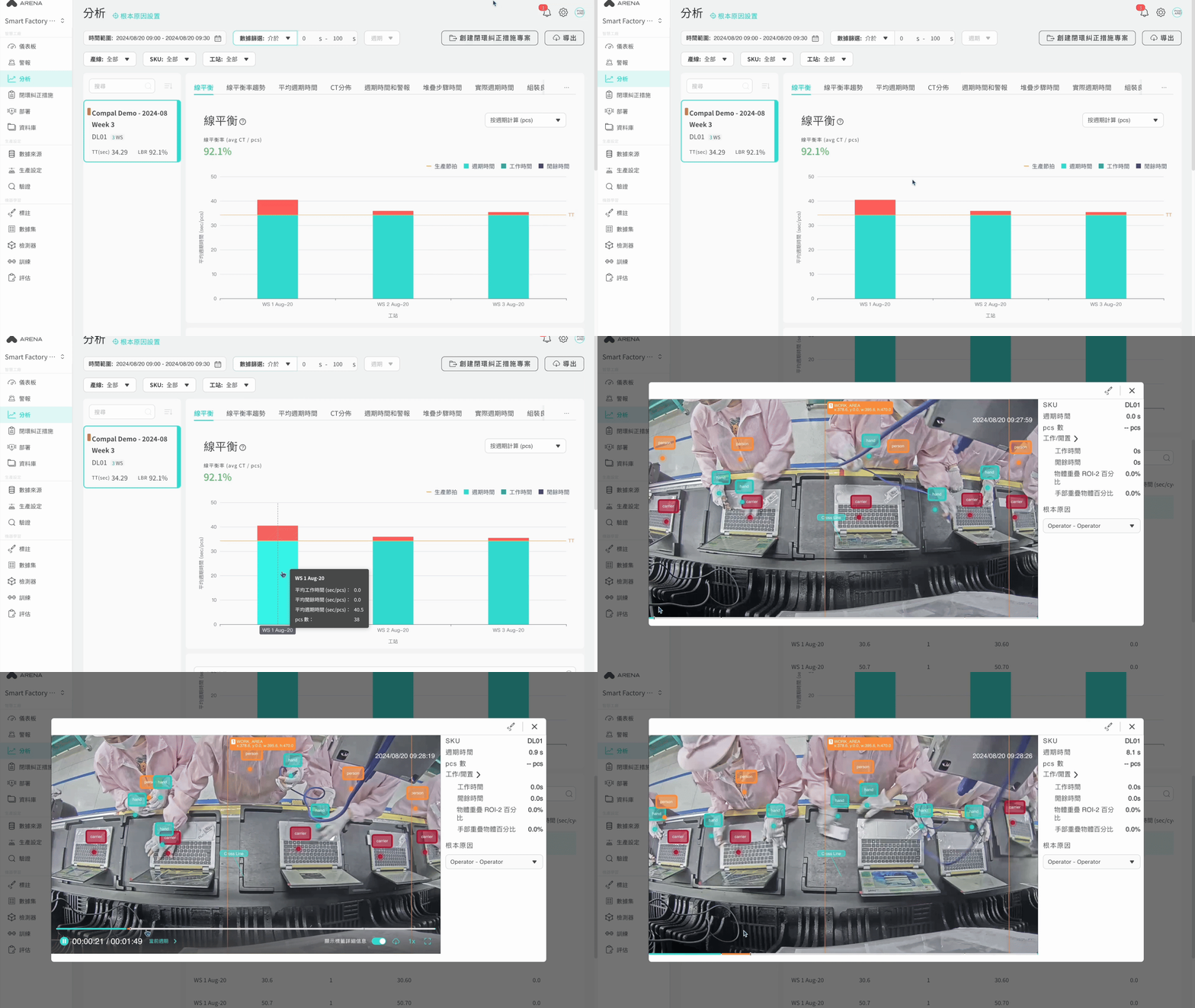
HOP combines production video with AI vision analysis to give a complete, visual, real-time view of the line.
Want to see more of AI-driven in-process quality control?
2. Let data drive the improvement
Traditional quality management leans on manual records and manual analysis, which cannot capture everything that happens on a line. As lines grow in size and complexity, manual effort alone can no longer keep up with continuous improvement.
“Reviewing a line by hand, a time study can take up to 48 hours per product.”
AI vision automates the collection and analysis of line data, takes most of that load off the team, and lets quality staff spend their time on decisions and improvement planning instead.

AI vision detects wheel brake disc tightening operation
3. Track improvement results digitally
Without hard data, it is hard to prove that an improvement worked, which slows down continuous improvement and erodes management confidence.
HOP keeps a digital record of every improvement action, with a clear history and rationale behind each one. Current managers can track results, and whoever takes over next inherits a traceable, reusable knowledge base instead of starting from scratch. That cuts communication overhead and shortens the path to resolution.
With continuous data tracking and results analysis, a plant can verify that improvements actually took hold, keep tuning line performance, and make quality gains that last.
Continue reading:
The advantages of bringing AI into quality management
5 ways HOP strengthens production and quality control
Table of Contents